Theme — how colour stays in cloth
Bonding
The dye molecule forms a covalent bond with the fibre and will not let go.
See
The bag carries a single colour name. Dissolve it and use it for ice dyeing, and as the ice melts the colour can break apart into several colours spreading across the cloth. Dharma Trading Co., a dye retailer, explains that when a mixed colour (a colour made by blending dyes) is used for ice dyeing, the original pure colours split out as the melting ice pulls the dye through the fabric.[1] Mixes of three or four colours, such as black, grey and brown, can split dramatically. Dharma also says that ice dyeing with pure colours, made from a single dye, is much less dramatic.[2]
Evidence for this paragraph (2)
[1]
1 source: Did You Know... Fiber Reactive Dye - Pure Colors vs Mixed · full evidence
[2]
1 source: Did You Know... Fiber Reactive Dye - Pure Colors vs Mixed · full evidence
Ask
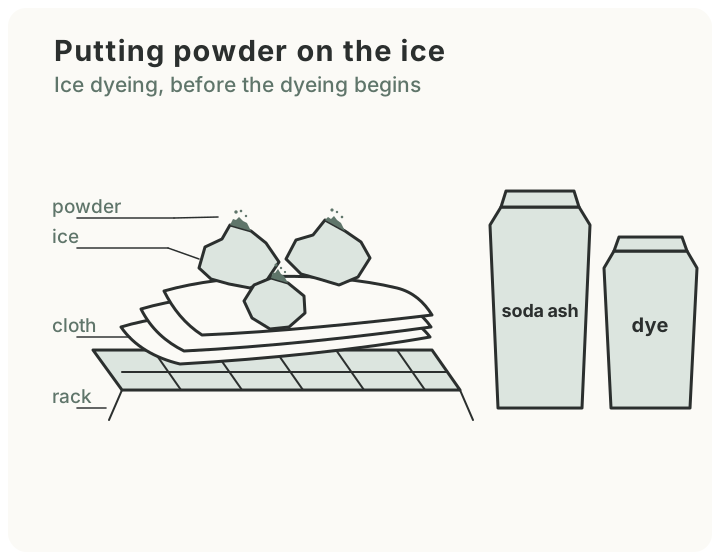
Beside a bag of dye there is usually another bag: soda ash (sodium carbonate). Explanations from the Kaken Test Center, a Japanese textile testing body, and others say that fixing a reactive dye to cloth needs an alkali such as this soda ash.[1] What makes the colour of a reactive dye stop coming off the cloth? This theme follows that question through the covalent bond (a link formed when atoms share electrons) that a reactive dye makes with the fibre. At the end we return to the scene in which the colour splits apart on its way to becoming permanent.
Evidence for this paragraph (1)
[1]
2 sources: 反応染料; 染色技術者のための染料化学(その3)2. 反応染料 · full evidence
Explain
The explanation that a reactive dye dyes by forming a covalent bond with the fibre agrees across four sources: the Kaken explanation, the dye retailer Dharma, the series "Dye Chemistry for Dyeing Technologists" (Part 3) written by Kunihiko Imada in the Journal of the Textile Machinery Society of Japan (in Japanese), and the technical pages of Iwase Shoten Co., Ltd. (Somelabo), a Japanese dye retailer.[1] Imada says that the ways in which dye and fibre join in dyes for cellulose fibres fall into three modes. Reactive dyes dye through a stable covalent bond, which has the highest bond energy (a measure of how strong a link is) of the three. For this reason he explains that their fastness (resistance to colour loss or transfer) to water, sweat and washing is especially good.[2] He also says that reactive dyes were announced in 1956 and are the newest of the dye classes.[3] Nobuhiro Kiyoshima (formerly of Descente Ltd.), writing in "Apparel Sanpomichi", a column published by the Nissenken Quality Evaluation Center (in Japanese), likewise says that because reactive dyes bond covalently, their wet fastness (resistance to colour change and colour transfer in water, sweat and washing) is comparatively good. But they are not a cure-all. He notes reports that after long storage the dye can hydrolyse (react with water itself) through moisture in the air, and colour bleed (dye seeping out of the cloth and staining its surroundings) has occurred. He names fixative treatment as one countermeasure.[4]
Evidence for this paragraph (4)
[1]
4 sources: 反応染料; Tie-Dye Instructions and 2 more · full evidence
[2]
1 source: 染色技術者のための染料化学(その3)2. 反応染料 · full evidence
[3]
1 source: 染色技術者のための染料化学(その3)2. 反応染料 · full evidence
[4]
1 source: 第53回:ケーススタディ⑨色の変化~汚染・色泣き~(アパレル散歩道) · full evidence
In Imada's account, the routes by which a dye joins the fibre fall broadly into two.[1] He says that the aliphatic vinyl sulphone (sulphatoethylsulphone) joins cellulose fibre by a "nucleophilic addition reaction", and the heterocyclic monochlorotriazine by a "nucleophilic substitution reaction".[2][3][2][4] This reaction competes with hydrolysis, in which the dye reacts with water itself. Imada states that under practical dyeing conditions the reaction with the fibre proceeds preferentially.[5] If the dyeing temperature is above the optimum range, hydrolysis takes over and the fixation rate (the share of the dye used that ends up dyed onto the fibre) falls. If it is too low, the reaction with the fibre is delayed and fixation falls short, he adds.[6]
Evidence for this paragraph (6)
[1]
1 source: 染色技術者のための染料化学(その3)2. 反応染料 · full evidence
[2]
1 source: 染色技術者のための染料化学(その3)2. 反応染料 · full evidence
[3]
Scope: Cellulosic fibre
 textbook ・
 checked against the source by AI
[4]
Scope: Cellulosic fibre
[5]
1 source: 染色技術者のための染料化学(その3)2. 反応染料 · full evidence
[6]
1 source: 染色技術者のための染料化学(その3)2. 反応染料 · full evidence
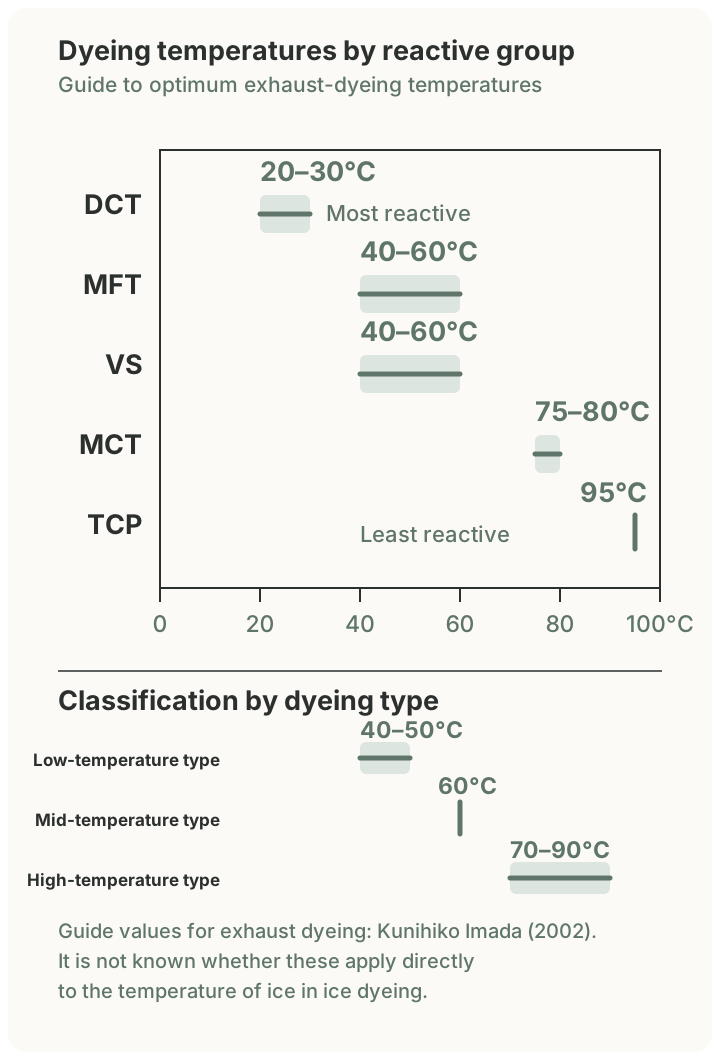
From Imada's explanation so far, this site takes it that the temperature at which each reactive group dyes best differs because of a tug-of-war with hydrolysis; a reactive group is the part of a dye molecule that reacts with the fibre. This is this site's reading. Imada's guide temperatures are about 40 to 50°C for the low-temperature type, 60°C for the mid-temperature type and 70 to 90°C for the high-temperature type. By reactive group, he gives 20 to 30°C for dichlorotriazine (DCT), the most reactive; 40 to 60°C for monofluorotriazine (MFT) and vinyl sulphone (VS); 75 to 80°C for monochlorotriazine (MCT); and 95°C for trichloropyrimidine (TCP), the least reactive.[1][2][3][4][5][6] Procion MX, widely used for home tie-dye and ice dyeing, is placed in Imada's figure and tables in the low-temperature type: the most reactive, with the lowest dyeing temperature.[7][8] Paula Burch, who writes explanations for makers, says that Procion MX is described as a dichlorotriazine dye with two chlorine atoms on its ring. She says these two chlorine atoms are the sites that react with the hydroxyl groups of cellulose. She also cautions that manufacturers often do not disclose dye structures, which makes them hard to confirm from the literature.[9] Dharma explains that this cool-water dye reacts slowly, depending on temperature and pH. It also warns that too much heat can cause the colour to fail to bond.[10] However, Imada's figures are guides for exhaust dyeing, in which cloth is dyed by immersing it in a dye solution. How far the same holds for ice dyeing, where the powder goes directly on the cloth and the temperature is that of ice, cannot be told from his explanation (see the questions at the end).
Evidence for this paragraph (10)
[1]
1 source: 染色技術者のための染料化学(その3)2. 反応染料 · full evidence
[2]
Scope: Exhaust dyeing
[3]
Scope: Exhaust dyeing
[4]
Scope: Exhaust dyeing
[5]
Scope: Exhaust dyeing
[6]
Scope: Exhaust dyeing
[7]
1 source: 染色技術者のための染料化学(その3)2. 反応染料 · full evidence
[8]
1 source: 染色技術者のための染料化学(その3)2. 反応染料 · full evidence
[9]
1 source: Frequently Asked Questions About Dyeing: structure of Procion MX dichlorotriazine dyes · full evidence
[10]
Scope: Procion-type reactive dye, per Dharma Trading Co.'s explanation
 manufacturer statement ・
According to the Kaken explanation, an alkali is also needed to drive the reaction with the fibre. After the fibre has taken up the dye from the dye bath, an alkali is added and the two are joined by a chemical reaction. Imada also says that adjusting the pH matters and that the type of alkali does not. He states that soda ash is widely used because adding about 10 to 20 g/L tends to bring the pH to around 11.5, which he gives as the optimum dyeing pH for the mid-temperature type.[1][2] These figures concern exhaust dyeing. They are not statements about continuous dyeing, in which cloth is dyed while being fed through continuously, or about printing, in which a dye mixed into a paste is applied to the cloth in a pattern. Dharma and Burch explain that the role of soda ash is to raise the pH so that the fibre molecules can react with the dye.[2] Dharma says that a pre-soak, in which the cloth is soaked in a soda ash solution beforehand, brings the pH of the cloth to about 10.5. It adds that this lets reactive dyes work at room temperature.[3][4] Burch cautions that baking soda (sodium bicarbonate) is much less basic and will not substitute for soda ash in most dyeing recipes.[5]
Evidence for this paragraph (5)
[1]
2 sources: 反応染料; 染色技術者のための染料化学(その3)2. 反応染料 · full evidence
[2]
includes a limiting source; 4 sources: What is soda ash, and what's it for in dyeing?; Dharma's Fiber Reactive MX Dyes FAQ and 2 more · full evidence
[3]
Scope: With Dharma's recipe (1 cup soda ash per gallon of water)
[4]
[5]
includes a limiting source; 3 sources: What is soda ash, and what's it for in dyeing?; Dharma's Fiber Reactive MX Dyes FAQ and 1 more · full evidence
The role of salt is separate from that of the alkali. Imada says that reactive dyes have a lower affinity for the fibre than direct dyes (affinity here means how readily, under given conditions, a dye stays on the fibre rather than in the liquid), so they need relatively large amounts of inorganic salt. The recommended amount in exhaust dyeing is about 50 to 80 g/L.[1] In Dharma's tub dyeing method (dyeing in a tub or bucket), salt and dye load the dye onto the cloth. Dissolved soda ash is then added to raise the pH, and about one hour is allowed for fixing.[2] For tie-dye and ice dyeing, where the powder goes directly on the cloth, Dharma says to soak the cloth in soda ash first.[3] The order differs, but this site takes it that the role is the same: the alkali creates the conditions in which the reaction can take place. This is this site's reading.
Evidence for this paragraph (3)
[1]
1 source: 染色技術者のための染料化学(その3)2. 反応染料 · full evidence
[2]
1 source: Dharma's Fiber Reactive MX Dyes FAQ · full evidence
[3]
Scope: Dharma soda ash product page and tie-dye instructions
Once the dye is on, the cloth is left for a set time. For tie-dye, Dharma explains, the cloth is kept damp in a plastic bag for at least 4 hours, or preferably 24 hours for the brightest colours. Below 70°F (about 21°C) it takes longer. For ice dyeing it likewise says to leave it for 24 hours.[1][2] Another dye shop, PAC Fabric Dyes, says to leave the cloth unrinsed for 3 hours even after the ice has fully melted.[3] None of these pages presents the times as a measurement. Dharma states that after 24 hours the sites on the cellulose where dye can bond should be filled with dye molecules. The excess dye that has not bonded is then washed away with a warm rinse and detergent.[4] In the same company's tie-dye procedure, the cloth is first rinsed under cold running water with the ties still on. It is then untied and rinsed in lukewarm water until the water is almost clear, and put straight into the washing machine.[5] In its ice dyeing procedure, the cloth is rinsed under cold running water until the water is almost clear, then machine-washed with hot water and dyer's detergent.[6]
Evidence for this paragraph (6)
[1]
Scope: Tie-dye; kept damp in a plastic bag
[2]
Scope: Ice dyeing; tubs covered with plastic
[3]
1 source: アイスダイタオル · full evidence
[4]
Scope: As explained by Dharma
[5]
Scope: Tie-dye
[6]
Scope: Ice dyeing
Washing out the dye that has not bonded affects how clear the colour is. Imada explains that before soaping (the step that washes away dye and other matter that has not bonded to the fibre), dye that has only hydrolysed, without reacting with the fibre, remains on the fibre. In this state wet fastness is poor, and removing it takes thorough soaping at 95 to 98°C for about 10 minutes.[1][2] Burch says that a reactive dye that has been properly fixed and thoroughly washed out should not need a colour fixative in the first place.[3] Katsuraya Fine Goods Co., Ltd. (Miyako-zome), a Japanese home-dye maker, also writes that its own reactive dye, "React", needs no colour fixing after dyeing.[4] However, Burch writes that some industries, such as those where water use is restricted, sometimes use a cationic colour fixative (one with a positive electric charge) in place of thorough washing-out, to save cost.[5] The sources thus contain both the view that a fixative is unnecessary and the view that it is sometimes used. How a colour fixative itself holds the dye is covered in the themes "Drawn by charge" and "Glued on".
Evidence for this paragraph (5)
[1]
1 source: 染色技術者のための染料化学(その3)2. 反応染料 · full evidence
[2]
[3]
1 source: Is there a fixative that will make dye permanent? What is Retayne? · full evidence
[4]
[5]
1 source: Is there a fixative that will make dye permanent? What is Retayne? · full evidence
The reactive groups of these dyes also have a property that calls for care. Imada, with the weighing and dissolving of dye powder in a dyeing plant in mind, explains that the reactive group can also react with the amino groups of proteins in blood. If dye that is still unreacted gets into the body, it can therefore cause sensitisation (the body becoming hypersensitive to a substance), such as allergy. Because sensitisation of the respiratory tract by inhaled dust can lead to life-threatening accidents, he says, major manufacturers display warning labels.[1] A safety data sheet for one home-use dye (Jacquard's Procion MX, Lemon Yellow) likewise says that dyes of this type can cause respiratory sensitisation in some people. It advises avoiding inhaling aerosol or dust.[2] Imada adds, however, that the concern about sensitisation applies only to dye that is still unreacted and active. He also says that dye in the dyed cloth or in dyeing effluent has already bonded to the fibre or hydrolysed, so it is not a problem.[3]
Evidence for this paragraph (3)
[1]
1 source: 染色技術者のための染料化学(その3)2. 反応染料 · full evidence
[2]
Scope: Home-use dye safety data sheet (Procion MX Lemon Yellow)
[3]
Scope: Dyed fabric and dyeing effluent
Check the conditions
The explanation so far holds for the combination of a reactive dye with cellulose fibres (cotton, linen, rayon and so on). Silk and wool change the story. Imada says that reactive dyes are also used on silk and wool. Dharma explains that on silk and wool the colours can shift, a true black is not possible, and mixes containing blue shift towards the colours of the other components.[1][2][3] It also says that blue does not bond well with silk.[3] On soda ash, Burch and Dharma's soda ash product page say it can be used on silk with caution, but that for wool acid dyes, which use heat or steam rather than soda ash, are better.[4] Another Dharma page, its tie-dye instructions, says that wool and silk can also be dyed if the amount is halved and the wait kept to 4 to 6 hours. On wool, then, even the same company's pages disagree.[4]
Evidence for this paragraph (4)
[1]
2 sources: 反応染料; 染色技術者のための染料化学(その3)2. 反応染料 · full evidence
[2]
2 sources: 反応染料; 染色技術者のための染料化学(その3)2. 反応染料 · full evidence
[3]
2 sources: Dharma's Fiber Reactive MX Dyes FAQ; Tie-Dye Instructions · full evidence
[4]
3 sources: What is soda ash, and what's it for in dyeing?; Soda Ash Fixer (product page) and 1 more · full evidence
Vinegar, which helps dyeing of animal fibres, has a different role on cotton. Katsuraya Fine Goods explains that vinegar is an auxiliary that helps silk and wool take dye. It cautions that adding it when dyeing plant fibres such as cotton does not fix the colour and instead stops the dye taking.[1] Burch also states that vinegar and salt are not colour fixatives, and that soaking already-dyed clothes in them will not set the dye.[2] Neither source gives a chemical reason why it does not work on cotton.
Evidence for this paragraph (2)
[1]
Scope: Dyeing cotton with Katsuraya's Miyako-zome dyes
[2]
Scope: As an after-treatment on already-dyed items
 practitioner's record ・
Look again
On the splitting of colours, known as colour splitting, Dharma gives as its reasons that dye molecules differ in size and that colours differ in how fast they strike (become permanent) in the presence of soda ash.[1][2] This is the company's own explanation and rather than a finding from independent research. How to tell pure colours from mixed ones, and the relation to how wet the cloth is, are covered in the article "Colour splitting in ice dyeing".
Evidence for this paragraph (2)
[1]
1 source: Did You Know... Fiber Reactive Dye - Pure Colors vs Mixed · full evidence
[2]
1 source: Did You Know... Fiber Reactive Dye - Pure Colors vs Mixed · full evidence
Back once more to the boundary between the powder on the ice and the cloth after it has melted. This site takes that boundary to reflect, one by one, the conditions checked in this theme: whether the pH was high enough for the alkali to work, whether the dye was a pure colour or a mixed one, and whether the time and the temperature were sufficient. This is this site's reading. When several colours show up in one piece of cloth, the way of looking that this theme leaves you with is to work out which of these conditions was off.
Terms in this theme
- Reactive dye
- Soda ash (sodium carbonate)
- Procion MX (reactive dye brand)
- "Remazol" type reactive dye
- Reac dye
- Ice dyeing
- Colour splitting
- Rinsing and washout
- Curing (batching) after dye application
- Silk
Questions (🧪 marks those that could be tested at home)
- 🧪 Does the finished result differ between soaking in soda ash first and applying it afterwards?
- 🧪 Where does the figure of 48 hours for ice dyeing come from? The sources checked give 24 hours at most.
- 🧪 At the temperature of ice, how far does a low-temperature-type reactive dye actually react?
- 🧪 Why is it said that rinsing first in cold water "stops the reaction"? Practitioners give explanations, but they have not been verified.
- 🧪 Does the wetness of the cloth change how a mixed colour splits? (Testing Dharma's caution at home.)
- 🧪 Is a colour fixative needed? Compare colour transfer with and without one.
- Why vinegar stops cotton taking dye: Katsuraya Fine Goods and Burch describe only the phenomenon, and the sources give no mechanism. A newspaper column, on the other hand, carries a saying that in old households salt and vinegar were used to fix indigo dyeing, which conflicts with the specialists' accounts.
- 🧪 When the colour comes out pale, what is responsible? The sources offer several candidates, including pH, temperature and deterioration of the soda ash, but which of them matters, and by how much, under home conditions has not been confirmed.
The limitations noted for some sources are recorded in Japanese only — see the Japanese edition.