Theme — how colour stays in cloth
Glued on
The colourant (pigment) does not bond with the fibre; a resin binder glues it to the surface of the cloth.
See
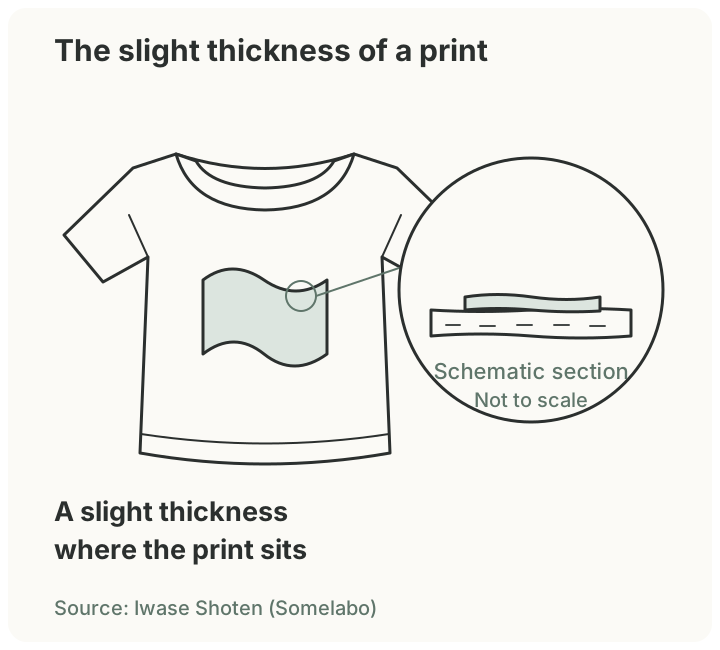
On some printed T-shirts you can feel a slight thickness in the design when you run a finger over it. Iwase Shoten Co., Ltd. (Somelabo), a dye shop, explains that pigment printing colours the cloth with a mixture of pigment and binder (a sort of adhesive that fixes the pigment to the fibre), so the result is somewhat thicker and has more presence than a dye print.[1] An explainer page from Nissha Communications, a company that does sublimation transfer printing, says that pigment printing lays ink on the surface of the cloth, so touching it means touching a layer of ink, which spoils the hand-feel of the fabric. The same page contrasts this with sublimation transfer printing (a technique for polyester in which heat turns the dye into a gas and moves it onto the cloth), where the dye soaks into the inside of the fibre.[2] A Q&A blog that Paula Burch writes for people who dye at home also says that when a printed design on a T-shirt is made with pigment (an ink close to paint), it resists colour-removing agents.[3]
Evidence for this paragraph (3)
[1]
1 source: 顔料プリント(やさしい染料講座) · full evidence
[2]
1 source: 昇華転写プリントとは · full evidence
[3]
1 source: Overdyeing with yellow turned grey parts of the design pea green · full evidence
Ask
Dyes stay in cloth by bonding with the fibre as molecules, or by being drawn to it electrically. How, then, does a pigment stay on the cloth?
Explain
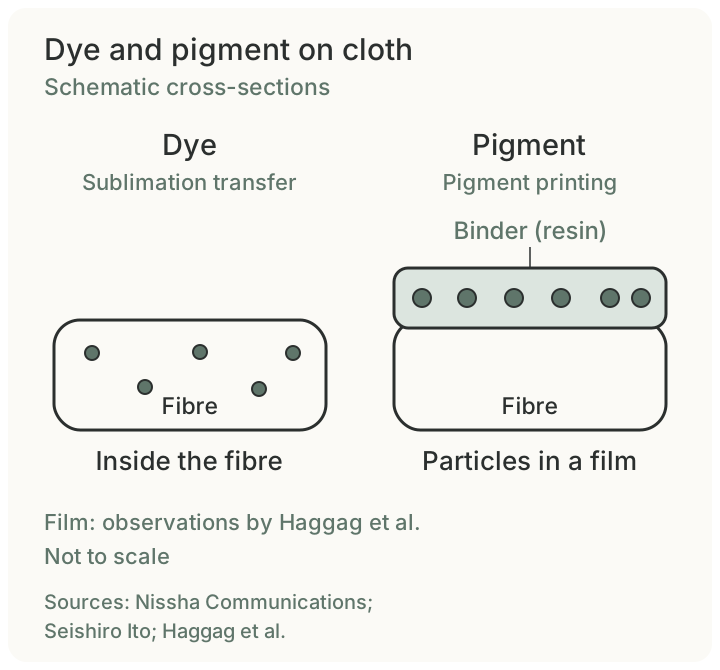
In the article "An Overview of Pigments", part of a lecture series in the Japanese journal Shikizai (in Japanese), Seishiro Ito defines a pigment as a powdery colourant that is insoluble or poorly soluble in water, oil and organic solvents. Unlike a dye, it does not colour the material by itself in a molecular state; it stays in particle form and is either fixed with the help of a binder, or dispersed and held inside the object.[1] A paper by Haggag and colleagues in Scientific Reports states the difference between dyes and pigments as follows. A dye is a coloured compound that bonds chemically with the fibre through particular functional groups (the parts of a molecule that carry out a reaction). A pigment consists only of colour molecules, with no reactive functional groups and no affinity for the fibre, so it has to be attached to the fibre with the help of a polymer compound called a binder.[2] Iwase Shoten calls the binder "a sort of adhesive that fixes the pigment to the fibre".[3] It also says that this fixing happens through heat, that is, dry-heat treatment (commonly called "baking").[4]
Evidence for this paragraph (4)
[1]
1 source: 顔料概論(最新顔料講座 第I講) · full evidence
[2]
1 source: Use of nano-scale synthesized polyurethane acrylate as a binder in textile printing · full evidence
[3]
1 source: 顔料プリント(やさしい染料講座) · full evidence
[4]
Scope: Binder in pigment printing
 manufacturer statement ・
 checked against the source by AI
Sources divide binders in different ways. Toya Senryo Shoten, a supplier of dyeing materials, splits instant binders (which can be used for screen printing simply by mixing in pigment) into two broad families, "penetration type" and "rubber type". It says the penetration type is made of acrylic resin, soaks well into the fabric and gives a look close to dyeing, and that the rubber type comes in both acrylic and urethane resin and gives a rubbery finish.[1][2] The shop lists the advantages of acrylic binders as low cost and resistance to "sublimation (bleed)", in which the dye in polyester fabric turns to gas under heat and seeps out.[3] Urethane binders, it says, cost more but are less tacky and excel in fastness (how well the colour resists washing, rubbing and so on), while also offering good stretch and hand-feel.[4] In this shop's scheme, only acrylic appears in the penetration type, and urethane appears only in the rubber type.[2] This source does not tell us whether other companies divide binders in the same way.
Evidence for this paragraph (4)
[1]
Scope: Pigment-printing binders
[2]
Scope: Types of pigment-printing binder
[3]
Scope: Acrylic-resin binder
[4]
Scope: Urethane-resin binder
The workings of the film itself have also been studied in peer-reviewed research. The Haggag study reports observations made under a microscope. With a formulation containing no binder, pigment particles do not stay on the fabric surface. With a formulation containing binder, the authors confirmed that a uniform, continuous film forms on the fabric surface and encloses the pigment.[1] The paper explains curing as follows. Radicals generated from persulfate (molecules in a reactive state, with one unpaired electron) attack the double bonds of the acrylate groups in the molecules of this binder (a polyurethane-acrylate type) and set off a chain reaction. As a result, several binder molecules join together and form a three-dimensional network.[2] For the same binder, the paper also describes a structure in which flexible "soft segments" follow the stretch of the fabric and prevent cracking, while "hard segments" provide strength.[3] An article in Textile Focus, a trade medium for the textile industry (Nanjiba Nur), classes binders broadly in two kinds: "non-reactive", which do not cross-link by themselves, and "reactive", which do.[4] The article lists the qualities of a good binder: it does not coagulate under the shear forces of printing (forces that push the ink sideways); its film is clear and of even thickness; it is elastic and not tacky; and it withstands chemical and mechanical stress. It says these properties trade off against one another.[5]
Evidence for this paragraph (5)
[1]
 experimental ・
[2]
[3]
[4]
 journalistic report ・
[5]
In the inks used for screen-printing T-shirts, the same idea of "forming a film with heat" appears in a different form. PERMASET (Colormaker Industries Pty Ltd), an Australian ink maker, describes plastisol ink as particles of PVC (polyvinyl chloride) resin dispersed in a plasticiser (an additive that softens the resin). At roughly 115 to 160 °C the particles fuse into a continuous film and set.[1] Water-based ink consists of polymer particles dispersed in water. According to PERMASET, it binds to the fibre in two stages: first the water evaporates, then the polymer particles cross-link. The company also says that several studies find 90% of the energy used goes on removing water, and only 10% on curing.[2] Lancer Group International, a Canadian ink maker, gives a stretch test (cracking means undercure) and an abrasion test as ways to check that plastisol has fused completely. It also says that most colour rubbing off comes from the ink not having been stirred enough before printing, while noting that this, too, is one sign of undercure.[3] Hirofumi Morita, a practitioner who publishes his records on note, describes a problem when printing on polyester. When rubber ink is cured at about 170 °C, the dye in the fabric can rise to the surface under heat and enter the ink, changing its colour. As an example, he says that when white is printed on a black T-shirt, the fabric's dye enters the white ink and turns it grey.[4] To counter this, Morita dries the ink at a low temperature, just below the point where the phenomenon occurs. Because low-temperature drying is insufficient and the print peels, his record says he adds an auxiliary agent to make up for it.[5] What this auxiliary agent is, exactly, is not stated in that record.
Evidence for this paragraph (5)
[1]
1 source: How to cure water-based screen printing inks · full evidence
[2]
2 sources: How to cure water-based screen printing inks; Heat Curing of PERMASET Inks · full evidence
[3]
1 source: Special Problems of Plastisol Ink · full evidence
[4]
1 source: シルクプリントの豆知識 ブリード(昇華)現象について · full evidence
[5]
Scope: Countering bleed when printing rubber ink onto polyester/blend T-shirts (the author's practice)
 practitioner's record ・
Keeping pigment on cloth is not something only new inks do. The Ryukyu Bingata Cooperative Association lists two features of Okinawa's Ryukyu bingata that it says have few parallels: stencilling, in which one stencil is used again and again to run a pattern continuously, and colouring that uses pigments and natural dyes together.[1] The introduction page of the Association for the Promotion of Traditional Craft Industries (a general incorporated foundation) makes the use of pigment for "iro-sashi" (applying colour to the pattern) and "kumadori" (shading) a requirement for designation.[2] On the same page, the traditional craft master Minoru Sato, who was interviewed, says that he makes nine kinds of pigment into a paste with gojiru (soybean milk), blends them, and applies colour gradually from pale reds towards deeper ones.[3] The Ryukyu Bingata Cooperative Association says gojiru has long been used as the fixative for colour application and is mixed with pigment ground into a paste to make the colours.[4] In holding pigment on the cloth, gojiru can be seen as occupying the same position as the binder in printing. This is this site's reading, and it is a comparison of roles only. No source says that gojiru forms the same kind of film as a resin. Even so, pigment is hard to fix, and according to the foundation's page there is a further step after colour application, called "rubbing-in (second pass)", in which colour is worked in again with a brush. The record says this rubbing brush is made with women's hair.[5] According to the Ryukyu Bingata Cooperative Association, ground-dyeing also uses a yellow plant dye taken from the bark of the fukugi tree, and indigo dyeing.[6][7] Before ground-dyeing, a resist paste is applied over the pattern to keep dye off it, in a step called "nori-fuse" (binushii).[8] iroai.jp, a website on textiles and dyeing, says that dyeing that combines indigo with shōen-zumi (a black ink made from the soot of burnt pine) was practised from early times at indigo dyers' shops across Japan.[9] The same article adds that at indigo dyers' shops in the Izumo region that dyed celebratory furoshiki (wrapping cloths), they sometimes dyed first, before the indigo, using gojiru brushed on and mixed with kneaded ink and tangara (a dye taken from the bark of the mangrove).[10]
Evidence for this paragraph (10)
[1]
1 source: 琉球びんがたができるまで · full evidence
[2]
1 source: 琉球びんがた(伝統的工芸品) · full evidence
[3]
1 source: 琉球びんがた(伝統的工芸品) · full evidence
[4]
1 source: 琉球びんがたができるまで · full evidence
[5]
1 source: 琉球びんがた(伝統的工芸品) · full evidence
[6]
1 source: 琉球びんがたができるまで · full evidence
[7]
1 source: 琉球びんがたができるまで · full evidence
[8]
1 source: 琉球びんがたができるまで · full evidence
[9]
[10]
Something close to a film also appears on the dye side. NICCA Chemical Co., Ltd., a maker of dyeing chemicals, gives two ways in which a colour-fixing agent used after dyeing works, on its product explainer page. One is making the dye hard to dissolve through an ionic bond between dye and fixing agent (covered in the theme "Drawn by charge"). The other is a "filming effect", which forms a film on the fibre.[1] On this one point, the dye stories in the themes "Bonding" and "Drawn by charge" connect with this theme.
Evidence for this paragraph (1)
[1]
Scope: per a NICCA Chemical product explainer page
Check the conditions
Each of the explanations so far applies only under limited conditions. The pairing of penetration and rubber types with resin families is the arrangement given on Toya Senryo Shoten's page.[1] The curing temperature of plastisol and the "90% / 10%" split for water-based ink are both guides given by the ink maker PERMASET.[2][3] Cotton Incorporated says the time a plastisol ink takes to cure depends on many conditions, including the type, colour and weight of the fabric, the thickness of the ink, and room temperature and humidity.[4] The number of pigments and the order of colours used in bingata colour application are the example of one interviewed workshop (Futenma Bingata Studio). The sources do not let us say that they apply to bingata as a whole.[5] The explanation that "pigment resists ultraviolet light because it originates from minerals" comes not from specialist textile literature but from a blog by Jizaiya ANNEX, a kimono shop. We record it here exactly as it stands.[6] The same blog says that pigments include inorganic pigments made from earth and minerals and organic pigments made mainly by petrochemical synthesis.[7] Whether that reasoning applies as it stands to organic pigments cannot be known from this source.
Evidence for this paragraph (7)
[1]
Scope: Types of pigment-printing binder
[2]
1 source: How to cure water-based screen printing inks · full evidence
[3]
2 sources: How to cure water-based screen printing inks; Heat Curing of PERMASET Inks · full evidence
[4]
1 source: Printing of Pigments and Special Effects(Technical Bulletin ISP 1017) · full evidence
[5]
1 source: 琉球びんがた(伝統的工芸品) · full evidence
[6]
1 source: 【沖縄の染織】紅型の鮮やかさの秘密。顔料ってなに?染料とはどう違うの? · full evidence
[7]
1 source: 【沖縄の染織】紅型の鮮やかさの秘密。顔料ってなに?染料とはどう違うの? · full evidence
Look again
Let us go back to the thickness you feel when you run a finger over a printed T-shirt design. Nissha Communications' explainer says that what you touch is the layer of ink sitting on the surface of the cloth. Haggag and colleagues report that with a binder-containing formulation, a continuous film enclosing the pigment forms on the fabric surface.[1][2] Putting the two together, what you touch is probably not dye that has gone into the fibre but a film of resin with pigment locked inside. This is this site's reading. In bingata, the Ryukyu Bingata Cooperative Association says gojiru is what holds pigment on the cloth. On the dye side, NICCA Chemical lists a film-forming action for the colour-fixing agent used after dyeing.[3][4] Even in the Izumo example, where indigo dyers mixed kneaded ink and other materials into gojiru, no source has yet been found that explains how the gojiru works.[5] The next time you touch a printed design, differences in thickness or stiffness might be a clue to whether it is a penetration type or a rubber type, plastisol or water-based.
Evidence for this paragraph (5)
[1]
1 source: 昇華転写プリントとは · full evidence
[2]
[3]
1 source: 琉球びんがたができるまで · full evidence
[4]
Scope: per a NICCA Chemical product explainer page
[5]
Terms in this theme
- Pigment-printing binder (general term)
- Acrylic-resin binder
- Urethane-resin binder
- Pigment
- Plastisol ink
- Water-based ink (for screen printing)
- Rubber-style screen-printing ink/binder
- Ryukyu Bingata
- Shōen-zumi (pine soot ink)
- post-dyeing colour-fixing agent
Questions (🧪 marks those that could be tested at home)
- How do the "penetration" and "rubber" types of binder differ in concrete terms, in the chemical structure of the resin and in how it sets on the fibre?
- 🧪 For a water-based pigment printing ink, how much difference is there in colour after washing, and in flaking, between a print that was baked (heat cross-linked) and one that was not? It looks testable: print two pieces on the same cloth with the same ink, apply heat to only one, wash both the same number of times and compare.
- 🧪 Can a print made with reactive dye be told apart from a print made with pigment by touch alone?
- What kind of material is the "auxiliary agent" that practitioners are said to add to counter bleed in rubber ink?
- Besides vermilion, which pigments are actually meant by the pigments used for colour application in bingata?
- How much formaldehyde can the cross-linking agents (melamine-resin types) of pigment-printing binders actually release?
- Is there a primary source that directly explains why digital pigment inkjet needs no steaming or washing afterwards, while reactive-dye inkjet does?
The limitations noted for some sources are recorded in Japanese only — see the Japanese edition.