Theme — how colour stays in cloth
Drawn by charge
The dye's charge and the fibre's charge attract each other and hold the dye in place.
See
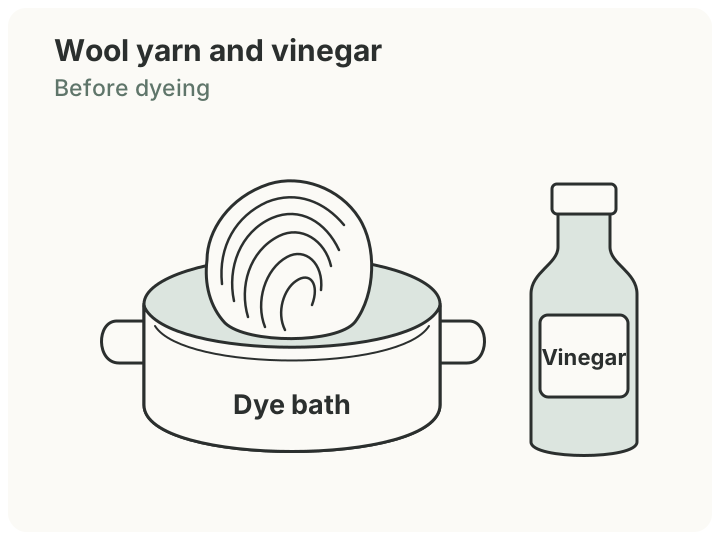
The author of the blog "Nyuujiirando Meshi" (New Zealand Food, in Japanese) recorded how they dyed wool yarn with food colouring. The blog records that 100% wool yarn was soaked in vinegar water, soaked with dissolved food colouring, wrapped in cling film, and heated in a microwave for a set time and amount. Once cool, it was washed in water mixed with washing-up liquid.[1] The author writes that the yarn dyed more easily than expected, and came out less prone to bleeding colour than they had thought.[2]
Evidence for this paragraph (2)
[1]
1 source: 食用色素で毛糸を手染めしたら、思ったよりあっさり染まった · full evidence
[2]
1 source: 食用色素で毛糸を手染めしたら、思ったよりあっさり染まった · full evidence
Paula Burch, a dyeing practitioner, also describes a procedure of the same kind, using unsweetened drink mix or food colouring.[1] Burch says the acid needed is conveniently supplied by the citric acid in the drink mix, and that when plain, unflavoured food colouring is used, the fibre is pre-soaked in white vinegar.[2] She also states that heat is required, and that dyeing at room temperature usually gives much less washfast results (here, washfastness means how well the colour resists coming out in the wash).[3] However, this way of dyeing works only on wool, silk and, at times, nylon.[4] On cotton it leaves only a stain, which she says mostly washes out.[5]
Evidence for this paragraph (5)
[1]
1 source: How can I tie dye with Kool-aid or food coloring? (Tie Dye with Kool-Aid) · full evidence
[2]
1 source: How can I tie dye with Kool-aid or food coloring? (Tie Dye with Kool-Aid) · full evidence
[3]
1 source: Using Food Coloring as a Textile Dye for Protein Fibers · full evidence
[4]
2 sources: Using Food Coloring as a Textile Dye for Protein Fibers; 食用色素で毛糸を手染めしたら、思ったよりあっさり染まった · full evidence
[5]
2 sources: Using Food Coloring as a Textile Dye for Protein Fibers; How can I tie dye with Kool-aid or food coloring? (Tie Dye with Kool-Aid) · full evidence
Ask
With the same vinegar and the same colouring, why do wool and silk take the dye while cotton does not? We will look at the difference through the electrical attraction between dye and fibre.
Explain
The Kaken Test Center, a Japanese textile testing body, describes acid dyes as a class that is dissolved in water with suitable auxiliaries, with the fibre dyed directly by immersion. The fibres they can dye are wool, silk, nylon and polyurethane, and the shades are brighter than those of direct dyes.[1][2][3][4][5][6]
Evidence for this paragraph (6)
[1]
 institutional summary ・
 checked against the source by AI
[2]
[3]
[4]
1 source: 酸性染料 · full evidence
[5]
Scope: As stated on Kaken's short explainer page; no test conditions or sources are given
[6]
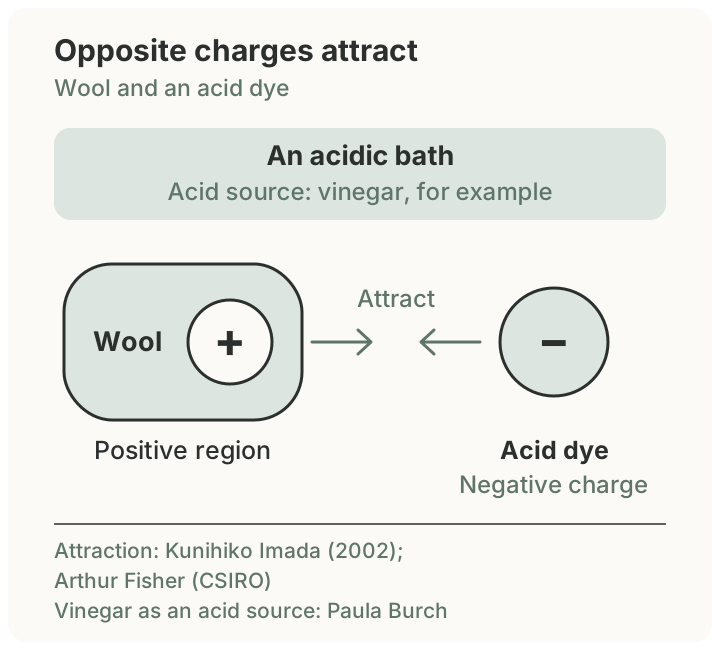
Kunihiko Imada, in the article series "Dye Chemistry for Dyeing Technologists" (Part 6) in the Journal of the Textile Machinery Society of Japan (in Japanese), explains the main way acid dyes attach to fibre as ionic bonding. An acid dye ionises in solution to become a dye anion (a dye molecule carrying a negative charge). This is said to bond with the parts of the fibre's amino groups (–NH2) that have become cationic (positively charged), in wool, silk and nylon. For wool, a teaching resource by Arthur Fisher of the Australian research body CSIRO likewise explains that, in acid dyeing, dye anions are drawn to positively charged ammonium groups.[1]
Evidence for this paragraph (1)
[1]
Scope: Acid dyes and protein/polyamide fibres (wool, nylon, etc.)
 textbook ・
"Chemistry for Dyeing" (in Japanese), a personal explanatory page on a Mukogawa Women's University server, shows the same mechanism through a demonstration with an acid dye called Orange II. It says that cotton molecules have only weakly positive and negative regions, so they cannot hold the dye back and it washes out.[1] It also states that acrylic molecules have no positively charged regions at all, so acid dyes cannot bond to them in the first place.[2] On food colouring, Burch states that its attachment to protein fibres takes the form of ionic and hydrogen bonds.[3] She adds that cotton has no way to hold the colour permanently, so it gets a stain rather than a dyeing.[4]
Evidence for this paragraph (4)
[1]
Scope: Demonstrated with the acid dye Orange II; not specific to food dyes
[2]
Scope: Demonstrated with the acid dye Orange II; not specific to food dyes
[3]
1 source: How can I tie dye with Kool-aid or food coloring? (Tie Dye with Kool-Aid) · full evidence
[4]
2 sources: Using Food Coloring as a Textile Dye for Protein Fibers; How can I tie dye with Kool-aid or food coloring? (Tie Dye with Kool-Aid) · full evidence
The acidity (pH) of the dye liquor is also key. In the same series, Imada says that the pH of the dye bath greatly affects the affinity of acid dyes for wool (the tendency of the dye to stay in the fibre rather than in the liquor). If the pH is extremely high, the dye is poorly taken up; if it is extremely low, uptake is too rapid and causes uneven dyeing.[1] The Nippon Kayaku technical document "Acid dyes: dyeing technique guide" (in Japanese) says that a levelling agent (a chemical that prevents uneven dyeing) helps by holding back the initial strike and preventing unevenness.[2] The same document explains that the effect of Glauber's salt (anhydrous sodium sulfate) changes with pH. In an acid bath at pH 5 or below it works to slow and level the dyeing, but in a bath near neutral it instead speeds up dye uptake.[3] Imada also says that nylon has fewer amino groups than wool, so there is an upper limit (the saturation value) to the number of ionic bonds the dye can form.[4]
Evidence for this paragraph (4)
[1]
Scope: pH and auxiliaries in exhaust dyeing of acid dyes (wool, nylon)
[2]
Scope: Use of a levelling agent with Nippon Kayaku acid dyes on wool
 manufacturer statement ・
[3]
Scope: Role of Glauber's salt in acid-dyeing wool
[4]
Scope: Saturation of ionic bonding between acid dyes and nylon
Silk can also be dyed with acid dyes or direct dyes, but a step called degumming comes first. This is explained by Ken Imai of the Textile Technology Center, Kyoto Municipal Institute of Industrial Technology and Culture, in the review article "Processing technology for silk fibre: degumming, immersion dyeing, printing and finishing" in the Journal of the Society of Fiber Science and Technology, Japan (in Japanese).[1] Imai says that raw silk contains, besides fibroin (the protein that forms the body of the silk fibre), 20 to 30% of a glue-like protein called sericin, and that degumming is the step of dissolving this sericin away.[2] Immersion dyeing of degummed silk divides into two kinds: a neutral bath, with no acid, and an acid bath made acidic with, for example, ammonium sulfate. Either way, direct dyes or acid dyes (including 1:2 metal-complex acid dyes) are used.[1] He writes that colourfastness is better in an acid bath, but that acid baths tend to be avoided, especially for fabric, because they readily cause abrasion (fraying).[3]
Evidence for this paragraph (3)
[1]
1 source: 絹繊維の加工技術−精練、浸染、捺染、整理(仕上)− · full evidence
[2]
[3]
1 source: 絹繊維の加工技術−精練、浸染、捺染、整理(仕上)− · full evidence
Cationic dyes, used on acrylic fibre, are defined by Kaken as "basic dyes modified for acrylic fibre".[1] Imada's series (Part 9) explains that the acrylic fibre on the market in 2003 had acidic groups, such as sulfonic acid groups, in the fibre, and says the cationic dye (a dye molecule carrying a positive charge) bonds ionically to these groups.[2] Up to a certain concentration (the saturation value, at which the sites in the fibre that can bond ionically with the dye run out), the dye is taken up almost completely because it bonds ionically. Beyond the saturation value, dyeing proceeds in the way disperse dyes do, with the dye dissolving into the fibre. That portion is held only weakly and is less fast, so Imada says actual dyeing must be done at concentrations at or below the saturation value.[3] The same article clearly distinguishes the "old-type basic dyes" (developed for mordant-dyeing cotton from the late nineteenth to the early twentieth century, and including mauve, the first synthetic dye) from today's "cationic dyes", developed from the 1930s onwards for acetate and acrylic.[4] Whether the two can be treated as the same object, on the sources this site holds, has not yet been confirmed.
Evidence for this paragraph (4)
[1]
[2]
Scope: Cationic dyes and acrylic fibre. As explained in a 2003 article in a series for dyeing technicians in a textile-machinery society journal; 'now' in the article means around 2003, when it was written
[3]
Scope: Saturation dyeing of cationic dyes on acrylic fibre, as explained in a 2003 article in a series for dyeing technicians in a textile-machinery society journal. Whether the same happens in home dyeing is not stated
[4]
Scope: History of basic dyes and the old-type/cationic distinction
Whether direct dyes are held by electrical attraction has not yet been confirmed, so for now they are handled provisionally within this theme. Kaken explains that direct dyes dye by dissolved dye molecules entering the gaps in the amorphous regions of the fibre. Imada's series (Part 2) likewise says that dyeing of cellulose fibre proceeds in the amorphous regions (the spaces between crystalline regions).[1] Imada lists, among the molecular features a direct dye needs for affinity to cellulose fibre, a linear molecule of relatively high molecular weight and groups capable of hydrogen bonding (such as amino and hydroxyl groups).[2] What follows is this site's reading. The way direct dyes are held is probably different in mechanism from the electrical attraction of the other dyes in this theme. But whether that mechanism is hydrogen bonding or another force between molecules has not been confirmed. Direct dyes are included in this theme so that they can be read together with the fixing treatment discussed next.
Evidence for this paragraph (2)
[1]
[2]
Scope: About the molecular structure of direct dyes
Imada says that direct dyes generally have low wet fastness (resistance to colour change and staining from water, sweat and washing), so a fixing treatment is often applied to make up for it.[1] Yoshitaka Saito of NICCA Chemical Co., Ltd., in a lecture article in the journal Shikizai (in Japanese), "On surfactants for textile use" (Surfactant Lecture Series, Lecture 11), states that fixing agents for cellulose fibres generally use a cationic polymer (a polymer carrying a positive charge).[2] The same article illustrates that a complex forms between the anionic (negative) part of the water-soluble dye and this cationic polymer, which stops the dye that has been taken up from leaching out.[3] Burch points out that cationic dye fixatives, because of their positive charge, belong to the class known as basic dyes.[4] It can be seen as a positive and a negative pairing appearing not only in the dye itself but also in the tool that makes up for the weakness of direct dyes. This is this site's reading. NICCA Chemical's product page also gives the same mechanism, as the dye becoming poorly soluble through ionic bonding with the fixing agent (complex formation). That page separately lists the formation of a film on the fibre surface, which holds the dye in place.[3][5] Burch, for her part, says that fixatives are needed only for dyes that are not very washfast.[6] She also says that soaking already-dyed cloth in vinegar or salt will not set the dye.[7]
Evidence for this paragraph (7)
[1]
Scope: Fixing treatment to improve the wet fastness of direct dyes
[2]
Scope: post-dyeing fixing agents for cellulosic fibres, per a technical review by a NICCA Chemical engineer
[3]
Scope: regarding fixing agents for cellulosic fibres
[4]
Scope: Burch's view
 practitioner's record ・
[5]
Scope: per a NICCA Chemical product explainer page
[6]
Scope: Burch's view
[7]
Scope: As an after-treatment on already-dyed items
The mechanism that Imada's series (Part 7) explains, dyeing with dye molecules that form coordination bonds with a metal (metal-complex acid dyes), is not covered in this theme but in the theme "Held by metal".[1][2]
Evidence for this paragraph (2)
[1]
1 source: 染色技術者のための染料化学(その7)6.2 金属錯塩酸性染料 6.3 酸性媒染染料 · full evidence
[2]
2 sources: 染色技術者のための染料化学(その7)6.2 金属錯塩酸性染料 6.3 酸性媒染染料; 14. Wool Dyeing Principles and Techniques (WOOL482/582 Wool Processing, Notes – Topic 14) · full evidence
Check the conditions
Everything explained so far applies only to particular fibres, chemicals and conditions. For acid dyes, the ionic bonding Imada describes concerns polyamide fibres such as wool, silk and nylon, and the fibres Kaken lists as dyeable are these plus polyurethane. In the demonstration on the personal page on the Mukogawa Women's University server, cotton barely holds the dye and acid dyes cannot bond to acrylic.[1][2][3][4] The effect of Glauber's salt changes with pH (Nippon Kayaku).[5] Imada's series (Part 6) gives figures for recipes for exhaust dyeing (dyeing by immersing the material in the dye liquor) of wool. Levelling types use 2 to 4% formic acid (pH 2 to 3), fast types use 1 to 3% acetic acid (pH 4 to 5), and milling types use 2 to 5% ammonium sulfate. All add 5 to 10% anhydrous Glauber's salt and dye at 100°C (boiling) for 40 to 60 minutes. These are examples of ordinary exhaust-dyeing conditions, not a claim that these exact conditions are always required.[6] The discussion of cationic dyes here concerns acrylic and modified polyester (which Kaken lists as fibres that cationic dyes can dye).[7][8] In Imai's review, the conditions for immersion dyeing of silk vary with whether the bath is acid or neutral and whether the material is yarn or fabric, and the methods of degumming also differ according to the chemicals used.[9][10]
Evidence for this paragraph (10)
[1]
Scope: Acid dyes and protein/polyamide fibres (wool, nylon, etc.)
[2]
[3]
Scope: Demonstrated with the acid dye Orange II; not specific to food dyes
[4]
Scope: Demonstrated with the acid dye Orange II; not specific to food dyes
[5]
Scope: Role of Glauber's salt in acid-dyeing wool
[6]
Scope: pH and auxiliaries in exhaust dyeing of acid dyes (wool, nylon)
[7]
Scope: As stated on Kaken's short explainer page; no test conditions or sources are given
[8]
Scope: As stated on Kaken's short explainer page; no test conditions or sources are given
[9]
1 source: 絹繊維の加工技術−精練、浸染、捺染、整理(仕上)− · full evidence
[10]
iroai.jp, a website on textiles and dyeing, describes felting of wool (shrinkage by felting) as a shrinking that can occur when moisture, high temperature with pressure, chemicals and the like act on it.[1] The stages in dyeing that sources point to, and how the way they list them differs, are covered in the article "Why wool shrinks and mats when dyed (felting)".
Evidence for this paragraph (1)
[1]
Scope: Felting shrinkage in wool generally.
Look again
Back to the yarn dyed with food colouring. Burch explains that vinegar (or the citric acid in the drink mix) supplies the acid, and that the colouring binds to the protein fibre by ionic and hydrogen bonds.[1][2] Burch counts food colouring among the acid dyes. Osamu Katayama, in a 1974 explanation, likewise places the tar-type food colours in use at the time in the class of "acid colorants" (Katayama's term, "sansei shikiso" in Japanese), which he says bond chemically with protein. He notes, however, that some xanthene-type colours merely cling physically as colloidal particles. It is not stated outright that Katayama's "acid colorants" mean the same class as the acid dyes of dyeing.[3] From this, Imada's explanation of acid dyes, in which the amino groups of wool become positively charged and bond with the negative part of the dye, is thought to apply to food colouring too. This is this site's reading, an inference from the class. It is not a statement confirmed for food colouring itself.[4] As for why cotton does not dye in the same liquor, Burch states that it has no way to hold the colour permanently, so it gets only a stain.[5] The personal page on the Mukogawa Women's University server says that cotton molecules have only weak positive regions, so they cannot hold the dye back (this is an explanation of the demonstration with the acid dye Orange II, not one limited to food colouring).[6] When you next look at a piece of cloth, you can use three things as clues: whether it is wool, silk, nylon or something else; whether an acidic auxiliary was used; and whether it was treated with a fixing agent after dyeing.
Evidence for this paragraph (6)
[1]
1 source: How can I tie dye with Kool-aid or food coloring? (Tie Dye with Kool-Aid) · full evidence
[2]
1 source: How can I tie dye with Kool-aid or food coloring? (Tie Dye with Kool-Aid) · full evidence
[3]
2 sources: 食用色素の化学; Using Food Coloring as a Textile Dye for Protein Fibers · full evidence
[4]
Scope: Acid dyes and protein/polyamide fibres (wool, nylon, etc.)
[5]
2 sources: Using Food Coloring as a Textile Dye for Protein Fibers; How can I tie dye with Kool-aid or food coloring? (Tie Dye with Kool-Aid) · full evidence
[6]
Scope: Demonstrated with the acid dye Orange II; not specific to food dyes
Terms in this theme
- Acid dye
- Cationic (basic) dye
- Direct dye
- Metal-complex acid dye
- Levelling (leveling) agent
- Anhydrous Glauber's salt (sodium sulfate)
- Post-dyeing colour-fixing agent
- Felting shrinkage
- Food tar colours (food colouring)
- Kool-Aid unsweetened drink mix
Questions (🧪 marks those that could be tested at home)
- 🧪 "Vinegar sets the dye": for which dyes and which fibres is that true? A column by Katsuraya Fine Goods Co., Ltd. (Miyako-zome) explains vinegar as an auxiliary limited to animal fibres, and says cotton will no longer dye. What actually happens when vinegar is added to a reactive dye on cotton looks testable at home too.
- If wool is dyed with an acid dye without a levelling agent, does it really dye unevenly? Nippon Kayaku's technical document says a levelling agent helps prevent uneven dyeing, but among the sources checked, none compares how evenly the same dye takes on the same cloth with and without one.
- Can the coordination bond between the metal of a metal-complex acid dye and the functional groups of the fibre be said to work in the same way as the coordination bond between the metal ions of a natural-dye mordant and the colourant?
- Can the old-type basic dyes (including mauve) and today's cationic dyes be treated as the same object?
- 🧪 Is the dye a Japanese dye shop sells for acrylic a disperse dye or a cationic dye? Comparing whether it actually dyes deeply might tell.
- 🧪 Among food colourings, do the xanthene types (such as erythrosine) dye well with a weaker acid and lower heat than the azo types (such as tartrazine)? Comparing how readily each colour takes in Kool-Aid dyeing may let you feel the difference. This dyeing uses heat, so an adult should do it, following the product labels and the sources' cautions.
The limitations noted for some sources are recorded in Japanese only — see the Japanese edition.