Theme — how colour stays in cloth
Made on the cloth
A naphthol base and a diazo component react on the fibre itself, making an insoluble colourant in place.
See
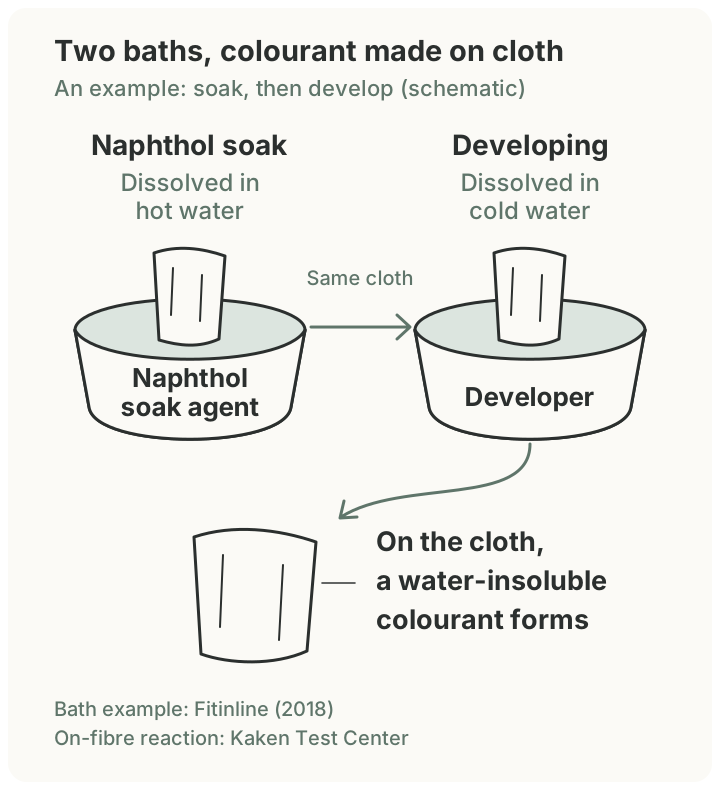
An Indonesian article explaining how to dye batik, a wax-resist dyeing technique (Fitinline, 2018; it carries a notice at the top marking it as an advertorial), gives two baths for dyeing one metre of cloth. One is a bath of naphthol agent, caustic soda and TRO oil dissolved in hot water. The other is developer salt dissolved in cold water. So it is not one dye dissolved in one bath: it takes two, one dissolved in hot water and one in cold.[1] A lab explanation from Keio University shows the same pairing on paper. A solution of beta-naphthol dissolved in alkali (solution B) is applied to filter paper with a glass rod, and a diazonium salt solution (solution A) is applied on top of it. The colourant forms on the paper.[2]
Evidence for this paragraph (2)
[1]
Scope: as example proportions in an Indonesian how-to article on batik dyeing (marked as advertorial); not a report from a specific workshop
 journalistic report ・
 checked against the source by AI
[2]
Scope: As stated in a Keio University lab explanation (naphthol and diazonium salt) and in a chapter reporting a laboratory synthesis. Not a check with commercial naphthol AS dyes
 textbook ・
 experimental ・
Ask
So how do two baths, a naphthol soak and a developer, produce a colour on the cloth that does not dissolve in water?
Explain
The short answer is that this dye is explained not as a dye dissolved beforehand and then transferred to the cloth, but as a colourant made on the cloth itself. The Kaken Test Center, a Japanese textile testing body, describes naphthol dyes as dyes that are applied by chemically synthesising a water-insoluble colourant on the fibre, and says that two materials, the naphthol soak agent and the developer, are reacted on the fibre.[1] Artemondo Co., Ltd., a Japanese maker of textiles for home furnishing, says this dye is also called an "azo dye" or an "azoic dye".[1] The naphthol soak is the step in which the naphthol is first taken up by the cloth. Developing is the step in which the developer is added afterwards to bring out the colour.
Evidence for this paragraph (1)
[1]
 institutional summary ・
 manufacturer statement ・
Mulyanto and Hartono (2025) state that naphthol does not dissolve in water, so caustic soda (sodium hydroxide) is needed to dissolve it.[1] The Keio University lab explanation shows a reaction in which adding aqueous sodium hydroxide to beta-naphthol gives sodium 2-naphthoxide, a salt (a compound made of a cation and an anion). A 2019 research note by Haruki Sugiyama and Shigeru Ohba, a report on the same student experiment published in the Hiyoshi Review of Natural Science of Keio University, takes up the same reaction and explains that becoming a salt makes it more soluble in water.[2]
Evidence for this paragraph (2)
[1]
1 source: Innovation of Batik Textile Works Using Wax Printing Techniques: Insights from Indonesia · full evidence
[2]
The developer component called the base is an aromatic amine, a compound with an amino group attached to a benzene ring or a similar ring. It is reacted with sodium nitrite under acidic conditions to make a diazonium salt. This is a general chemical explanation, and the reaction is called diazotization. The Keio University lab explanation states that the diazonium salt is unstable and decomposes easily, so it has to be handled at a low temperature of 5°C or below (cooled with ice water).[1]
Evidence for this paragraph (1)
[1]
1 source: 12.パラニトロアニリン赤の合成と染色(化学実験テーマ解説) · full evidence
How awkward diazotization can be is also recorded in an accident report. The research note by Sugiyama and Ohba (2019) reports that in a Keio University student experiment, mixing the reaction solutions when the sodium nitrite had not fully dissolved, or when ice-cooling was inadequate, suddenly released toxic nitrogen dioxide gas. The same note also records a case in which gas was released even though the sodium nitrite had been fully dissolved and the mixture ice-cooled according to the procedure. Through verification experiments, it establishes that the cause was a weighing error of the electronic balance (insufficient sensitivity at around 0.2 grams). In other words, the report says the cause lay not only in the handling procedure but also in the instrument used for measuring.[1]
Evidence for this paragraph (1)
[1]
Scope: as observed in a Keio University undergraduate chemistry-lab exercise
The Keio University lab explanation says that when the diazonium salt solution (solution A) is layered onto the beta-naphthol solution dissolved in alkali (solution B), a coupling reaction takes place (a reaction in which the diazonium salt and the naphthol join to form a molecule linked by an azo group) and a colourant is formed. This colourant is the water-insoluble colourant in the Kaken explanation seen above, and it is an azo colourant (a colourant with an azo group in the molecule, in which two nitrogen atoms are joined by a double bond). The paper by Isibor (2024) reports a procedure in which 1-naphthol dissolved in sodium hydroxide was added to the diazotized solution and the mixture was stirred vigorously for one hour to react.[1][2] Isibor's experiment does not use a commercial Naphthol AS dye itself, but it reports that the same kind of reaction was used to dye cotton and gave good light and wash fastness (how well the colour resists washing, rubbing and light).[3]
Evidence for this paragraph (3)
[1]
Scope: As stated in a Keio University lab explanation (naphthol and diazonium salt) and in a chapter reporting a laboratory synthesis. Not a check with commercial naphthol AS dyes
[2]
1 source: Synthesis of Dyes and the Textile Industry · full evidence
[3]
Scope: for the five lab-synthesised dyes reported in this chapter
The working procedure is set out on an English-language blog on dyeing and processing (dyeingworld1). It has six stages: (1) dissolving the naphthol component, (2) adsorption onto the fibre, (3) removing the excess by squeezing and a salt-water wash, (4) diazotizing the developer, (5) developing the colour by coupling in the diazonium salt solution, and (6) neutralising, soaping (a step that washes off excess colourant and the like remaining on the fibre surface), rinsing and drying.[1] The same blog says that an auxiliary called TRO (the full name is not given in the source) helps the naphthol to wet, to dissolve, and to penetrate the fibre.[2] It also says that the key to fastness lies in the intermediate drying and rinsing after the naphthol soak and in the final soaping. It states that deep shades that have not been soaped enough transfer colour to an adjacent white cloth even under light rubbing.[3]
Evidence for this paragraph (3)
[1]
 practitioner's record ・
[2]
[3]
The Indonesian article at the beginning says that naphthol dyes have been widely used by batik artisans as a synthetic dye that dyes quickly and gives strong colour.[1] However, this site's research has not yet found a primary source that says naphthol dyes suit batik "because they can dye at a temperature low enough not to melt the wax". Mulyanto and Hartono (2025) use the expression "cold naphthol dyes" but do not explain the reason as protecting the wax. Paula Burch says of a fibre-reactive dye used for home batik in the United States (Procion MX) that room-temperature water can be used and the hot water that would melt the wax is not needed.[2] That, however, is an explanation of a different dye. Whether this reasoning applies to naphthol dyes themselves is a question that has not yet been checked.
Evidence for this paragraph (2)
[1]
[2]
1 source: How to Batik · full evidence
A Japanese review of 1956 (Yumi Yamaguchi) states that Naphthol AS, the naphthol soak agent, was invented in 1911 at Griesheim-Elektron. The review does not state the nationality of the company.[1] The same review gives seven as the number of main grades of soak agent produced in Japan as of 1956.[2] It also says that about 60 developers were known, of which about 50 were produced in Japan.[3] On the other hand, a comparison table in Kunihiko Imada's series "Dye Chemistry for Dyeing Technologists" (in Japanese; Journal of the Textile Machinery Society of Japan, part 2, 2001) lists launch years of dyes for cellulosic fibres (cotton, linen and so on) and gives 1912 as the launch year of azoic (naphthol) dyes.[4] This site considers it possible that these are statements in different contexts, the year of invention and the year of commercial launch. But the two years have not yet been checked against each other.
Evidence for this paragraph (4)
[1]
Scope: as stated by this review, published in 1956
[2]
Scope: as described for domestic production in Japan as of 1956
[3]
Scope: as of 1956
[4]
Scope: Table 7 (characteristics of cellulosic-fibre dye classes)
According to an explanation by the Osaka Institute of Public Health, in Japan from April 2016 the Cabinet Order and the Ministry ordinance under the Act on the Control of Household Products Containing Harmful Substances were amended, and the regulation of household products containing "azo dyes that may generate specific aromatic amines" came into force.[1] The same explanation says that azo dyes can, on reduction, produce substances suspected of being carcinogenic, and lists 24 such substances as "specific aromatic amines". Products are covered when they contain more than 30 micrograms per gram of the household product for any one of them.[2] It says that the household products covered are limited to textile products with parts in direct contact with the skin, such as nappies, underwear, gloves, socks and sleepwear, and some leather products.[3] Sugiyama and Ohba (2019) write that the regulation applies to dyes, and that pigments are excluded.[4]
Evidence for this paragraph (4)
[1]
[2]
[3]
[4]
A document of the Ministry of Health, Labour and Welfare states that Germany in 1994 was the first country in the world to ban the use of certain azo dyes in textile products in prolonged contact with the skin.[1] The Osaka Institute of Public Health explanation says that by 2002 a similar regulation was also in operation in the EU.[2] Artemondo explains that it has not used naphthol dyes in its own products for some time, giving as one reason the regulation in force in Japan from April 2016.[3]
Evidence for this paragraph (3)
[1]
[2]
[3]
Scope: One home-fashion textile maker's (Artemondo) choice not to use naphthol dye
On the other hand, Fine Corporation and Okahata Sangyo Co., Ltd., both chemical trading companies, include naphthol dyes in their lists of products handled as of 2026.[1] Both are trading companies serving industry, and business-to-business dealing appears to be assumed. Whether an individual or a small workshop can buy them in small quantities is not yet known from this site's research.
Evidence for this paragraph (1)
[1]
Scope: Current handling of naphthol dye by industrial chemical trading companies
Check the conditions
The Kaken Test Center lists cellulosic fibres and polypropylene as the fibres that can be dyed with naphthol dyes.[1][2] The comparison table in the Keio University lab explanation rates azoic dyes as best suited to plant fibres, suitable for nylon, and unsuitable for animal fibres (protein fibres).[3] Sugiyama and Ohba (2019) explain why they are unsuited to animal fibres as follows. When protein is soaked in a sodium hydroxide solution and heated, its peptide bonds (the bonds joining amino acids) undergo hydrolysis (a reaction in which the addition of water breaks them).[4]
Evidence for this paragraph (4)
[1]
[2]
[3]
Scope: from this teaching document's comparison table (plant fibre / animal fibre / nylon)
[4]
Scope: As a side remark in the section on the effect of dyes on skin in this 2019 research note. An earlier section of the same text describes soaking cotton cloth in sodium hydroxide solution as a pretreatment, but the sentence on animal fibres does not call it a pretreatment
For the situation in 1956, on the other hand, Yamaguchi's review says the dyes are used mainly on plant fibres such as cotton and rayon, but adds that they are also used on silk, wool, acetate rayon and synthetic fibres. It also lists products for wool and for synthetic fibres.[1][2] Whether this difference is a change over time, or a difference in use between actual industrial dyeing and teaching experiments, has not been checked by this site.
Evidence for this paragraph (2)
[1]
Scope: as described by this 1956 review for the situation in Japan at the time
[2]
Scope: Products as described in 1956 (Yamaguchi 1956 review); current availability is a separate question
On temperature, too, the Keio University lab explanation says that the diazonium salt has to be handled at 5°C or below.[1] The Indonesian article, on the other hand, has an example in which the naphthol soak bath is made by dissolving the naphthol agent and other materials in hot water.[2] Putting these two side by side, this site's reading is that where the low temperature matters differs from one step to another.
Evidence for this paragraph (2)
[1]
1 source: 12.パラニトロアニリン赤の合成と染色(化学実験テーマ解説) · full evidence
[2]
Scope: as example proportions in an Indonesian how-to article on batik dyeing (marked as advertorial); not a report from a specific workshop
On the properties of the dyed cloth, the FAQ of Tanaka Nao Dyeing Materials Store explains that among its chemical dyes for cotton and linen, the brands believed to be reactive (Reac, Hannol, Remazol) or direct (Sirius) can mostly be discharged (having the dyed colour removed with chemicals), but cloth dyed with naphthol cannot be discharged at all.[1] On fastness, the dyeingworld1 blog says the following about dyeing cotton. The fastness of correctly processed naphthol dyeings is often the same as, or only slightly inferior to, that of vat dyeings (dyeings with vat dyes such as indigo, which are dissolved by reduction, applied, and then oxidised in air to bring the colour back), and naphthol dyes complement vat dyes with bright red, orange and Bordeaux shades that vat dyes lack.[2] In comparison with reactive dyes, it says that chlorine fastness is better with naphthol dyes, while rubbing and light fastness are better with reactive dyes, and that naphthol dyeing has more process variables.[3]
Evidence for this paragraph (3)
[1]
Scope: Tanaka Nao's discharge-printing FAQ for cotton/linen chemical dyes
[2]
Scope: for dyeing on cotton
[3]
1 source: Naphthols and Bases · full evidence
Look again
Back to the two baths at the beginning, one dissolved in hot water and one in cold.[1] The Kaken Test Center explained that the soak agent and the developer are reacted on the fibre to make a water-insoluble colourant. The Keio University lab explanation said that layering a diazonium salt solution onto a naphthol solution dissolved in alkali produces a colourant.[2][3] Applying these two explanations to the two baths at the beginning, what happens there is not the transfer of a colour that already exists to the cloth. It is that the naphthol component laid down in the soak and the developer prepared separately combine for the first time on the cloth, making a new colourant molecule. This is this site's reading. It differs in its set of tools from the mechanism of indigo, where a colourant that has entered the fibre is oxidised back to its colour (covered in the theme "Dissolve, then return").
Evidence for this paragraph (3)
[1]
Scope: as example proportions in an Indonesian how-to article on batik dyeing (marked as advertorial); not a report from a specific workshop
[2]
[3]
Scope: As stated in a Keio University lab explanation (naphthol and diazonium salt) and in a chapter reporting a laboratory synthesis. Not a check with commercial naphthol AS dyes
The next time you meet this kind of dyeing, you can use it as a lead for thinking about whether the colour "goes into" the cloth or "is born" there, and what each of the two baths, the soak and the developing, is responsible for. And the dyeingworld1 blog writes that the key to fastness lies in the intermediate drying and rinsing after the soak and in the final soaping.[1]
Evidence for this paragraph (1)
[1]
Terms in this theme
- naphthol (azoic) dye
- synthesis of the colourant on the fibre
- diazotization
- azo coupling
- Naphthol AS
- beta-naphthol (2-naphthol)
- Para Red
- TRO (T.R. oil)
- naphtholation-and-developing dyeing procedure
- Regulation of specific aromatic amines in household products (Japan, 2016)
Questions (🧪 marks those that could be tested at home)
- Is there a primary source stating that naphthol dyes suit batik "because they can dye at a temperature low enough not to melt the wax"?
- Are there naphthol soak agents and developers still available in Japan that an individual or a workshop can buy, not in bulk but in small amounts?
- Can the "1911 invention" of the soak agent AS and the "1912 launch" of azoic dyes be explained by the difference between the year of invention and the year of commercial launch?
- On whether naphthol (azoic) dyes are used on animal fibres (silk, wool), is the difference between the statements of Yamaguchi (1956) and Sugiyama and Ohba (2019) a technical change over time, or a difference in use?
- 🧪 If you weigh the same object on several scales at home (a kitchen scale, a jewellery scale and so on), can you see a difference in sensitivity at around 0.2 grams?
The limitations noted for some sources are recorded in Japanese only — see the Japanese edition.