Theme — how colour stays in cloth
Dissolve, then return
An insoluble colourant is reduced into solution, worked into the fibre, then returned to its original form by oxidation in air.
See
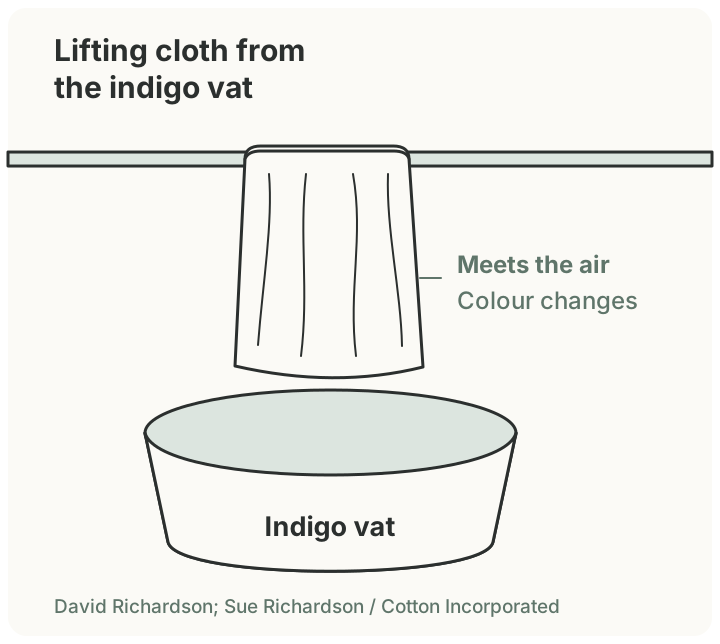
The blog "Aibatake", which records an indigo field in Okinawa, describes one stage of making doro-ai (mud indigo). Harvested Ryukyu indigo (Ryukyu-ai) is soaked in water, stems and all, and left to ferment for several days. Slaked lime is then dissolved little by little into the yellow-green liquid, with stirring, once the stems and leaves have been removed. The indoxyl in the liquid oxidises and becomes blue indigo. In time the liquid separates into a clear upper layer and a precipitate, and the settled indigo, once collected, is the doro-ai. That is what the record describes.[1] The same change of colour can be seen the moment cloth is lifted out of an indigo vat. In its entry "Indigo", Asian Textile Studies explains that reduced indigo is a pale yellow, and that in cloth exposed to air oxidation proceeds, passing through a greenish blue on the way to blue. Cotton Incorporated says that indigo, reduced to a very pale greenish yellow, begins to turn back to blue as soon as it meets the air.[2] Oxidation here means losing electrons, and reduction means gaining them. This theme is about the place where that mechanism is most easily seen.
Evidence for this paragraph (2)
[1]
1 source: 泥藍を作ろう(畑だより 2021年09月23日) · full evidence
[2]
4 sources: Indigo; 泥藍を作ろう(畑だより 2021年09月23日) and 2 more · full evidence
Ask
Why does a pigment that does not dissolve in water dissolve into a liquid once, and then return to its original colour on the cloth? Some sources say the same description applies not only to indigo but also to Tyrian purple and to sulfur dyes. The way the pigment is dissolved, however, differs greatly: by fermentation, by chemicals, or inside the body of a shellfish. We look at what the cases share, and at how they differ by region and by method.
Explain
According to Yoshiko Minami's account, the leaf cells of the Persicaria tinctoria plant (ai) accumulate large amounts of indican, a glycoside (a compound joined to a sugar).[1] When the leaf is damaged, the enzyme β-glucosidase hydrolyses indican into indoxyl and glucose.[2] Indoxyl is described as extremely unstable: on contact with oxygen in the air, its molecules link up without any help from an enzyme and become stable, insoluble indigo.[3] The reaction that the same source records, in which crushing a leaf turns your fingertips blue, is where indigo dyeing begins.[2]
Evidence for this paragraph (3)
[1]
Scope: The Polygonaceae plant “ai” (named Polygonum tinctorium in this source)
 textbook ・
 checked against the source by AI
[2]
Scope: When the leaf cells of ai are disrupted
[3]
1 source: タデ科植物アイのインジカン代謝 · full evidence
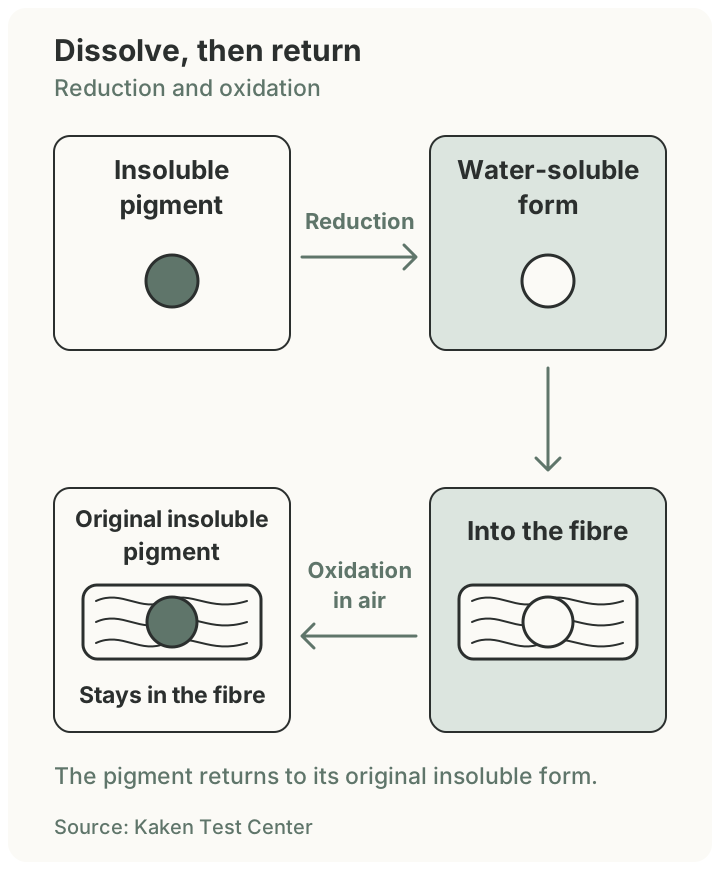
Following the Kaken Test Center's explanation of vat dyes (Kaken is a Japanese textile testing foundation), to colour cloth with indigo, the insoluble indigo must first be changed into leuco-indigo, a form that dissolves in water. It is then worked into the fibre and exposed to air, which returns it to the original insoluble indigo.[1] The centre's explanation of sulfur dyes likewise says that the insoluble dye is reduced and dissolved, taken up by the fibre, and then exposed to air so that it oxidises back into the original insoluble dye.[2] The name of this theme, "Dissolve, then return", refers to this round trip, which indigo and sulfur dyes share.
Evidence for this paragraph (2)
[1]
 institutional summary ・
[2]
The "dissolving" step, which is called building the vat, comes in two broad kinds: the fermentation vat and the chemical vat. Miyoko Kawahito explains the difference. In a chemical vat, a chemical reducing agent itself reduces the indigo directly. In a fermentation vat, by contrast, one has to make indirect arrangements, supplying the nutrients and the conditions that the reducing bacteria and the reducing enzyme they produce need.[1] What actually does the reducing in a fermentation vat is not the bacteria themselves but the reducing enzyme they produce and activate.[2] In Kawahito's account of the Awa-ai fermentation vat, the best temperature for activating the reducing enzyme is 45 to 50°C, while the bacteria themselves grow best at 30°C, and the alkalinity best for producing the enzyme is around pH 11.0.[3][4] The materials that keep the vat alkaline also differ. Kawahito explains that slaked lime dissolves poorly in water, so its effect lasts, whereas sodium hydroxide dissolves readily and acts quickly, but its effect does not last.[5] Dharma Trading Co. describes its "Pre-Reduced Indigo Crystals" as a home-use product: a synthetic indigo that has already been reduced by 60%, so the vat can be built with soda ash (sodium carbonate), which is milder.[6]
Evidence for this paragraph (6)
[1]
1 source: 連載〈阿波藍5〉染料液の作り方(藍を建てる) · full evidence
[2]
1 source: 連載〈阿波藍5〉染料液の作り方(藍を建てる) · full evidence
[3]
1 source: 連載〈阿波藍5〉染料液の作り方(藍を建てる) · full evidence
[4]
1 source: 連載〈阿波藍5〉染料液の作り方(藍を建てる) · full evidence
[5]
1 source: 連載〈阿波藍5〉染料液の作り方(藍を建てる) · full evidence
[6]
2 sources: Pre-Reduced Indigo Crystals (product page, Description + Instructions tabs); Pre-Reduced Indigo Instructions · full evidence
Miyoko Kawahito describes sukumo, the raw material of Japanese indigo dyeing, as made by fermenting dried indigo leaves. She distinguishes this from the precipitation method, in which fresh leaves are soaked in water to extract the pigment, and treats the two as different ways of processing natural indigo.[1] The sources disagree on the details of making sukumo. A record from Aizumi Town in Tokushima puts the turning of the pile ("kirikaeshi") at about 20 times over about 100 days. The Ai-no-ie ("House of Indigo") laboratory at Shikoku University gives 12 to 15 times, and Miyoko Kawahito (2015) gives 22 to 23 times over 90 to 100 days.[2][3][4] They appear to be describing the same step, but this site cannot judge whether the difference lies in what counts as one turn, or in differences between indigo makers or scales of work. According to Anna Hartl and colleagues, lime was used in large quantities in China and North-East India, but only in small amounts in late-19th-century British India. The use of lime in the precipitation method also varies from one producing region to another.[5]
Evidence for this paragraph (5)
[1]
1 source: 阿波藍の製造(藍師・栽培・染料作り)とその染料液の作成 · full evidence
[2]
1 source: すくもの加工 · full evidence
[3]
1 source: 「すくも」づくり · full evidence
[4]
1 source: 阿波藍の製造(藍師・栽培・染料作り)とその染料液の作成 · full evidence
[5]
The sources also give different answers to what the word "hon-ai" (literally "true indigo") refers to. Mizuno Dye Works classifies dyeing as "hon-ai-zome" as long as a plant indigo is used as the dye, even if chemicals such as reducing agents are used.[1] Riku Matsuzaki, an indigo dyer in Kyoto, says that within the sources he has looked at, he could find neither "hon-ai" nor "hon-ai-zome" as a term, and that the word began as a self-description by producers in Tokushima (Awa).[2] Sinkukan, a shop selling denim and workwear, gives its own view that within Japan "hon-ai" should be limited to goods dyed with sukumo indigo (Persicaria tinctoria) alone. It points out that "wari-date", a vat blending sukumo indigo with cheaper chemical indigo, is in some cases sold as "hon-ai-zome".[3][4] The three definitions differ, and this theme does not choose one of them as correct.
Evidence for this paragraph (4)
[1]
Scope: Mizuno Dye Works' explanation
 manufacturer statement ・
[2]
Scope: Riku Matsuzaki's personal view, based on his own review of historical sources
 practitioner's record ・
[3]
Scope: Sinkukan's stated view (explicitly framed as "our shop's view")
[4]
Scope: Sinkukan's stated view
Tyrian purple starts with a different pigment. Christopher Cooksey's review gives its main component as 6,6'-dibromoindigo, and explains that, unlike unbrominated indigo, it carries two bromine atoms at the 6 and 6' positions.[1] Apsana Ngangbam and colleagues, drawing on earlier studies, explain that the pigment arises from a precursor, tyrindoxyl sulfate, held in the mollusc's secretory gland. After hydrolysis by an enzyme, it passes through spontaneous oxidation and photolysis (a reaction in which light breaks up molecules) to become purple. Unlike indigo, the last step needs light.[2] That is about how the pigment forms, not about getting it into cloth. A report of a demonstration by the dye workshop tezomeya records a rule of thumb about handling the pigment once it has been reduced and turned yellow: strong light turns it into indigo, so the room lights are switched off while working.[3] However, we found no description in the academic papers checked for this site of an experiment confirming this light-driven change, that is, the loss of bromine. A paper by Jesús Emilio Michel-Morfín and colleagues includes, in the form of a citation, an account of commercial harvesting on Mexico's Pacific coast in the 1980s, in which the interval between milkings was not considered, causing mass mortality among the snails.[4]
Evidence for this paragraph (4)
[1]
2 sources: Preparation of Tyrian Purple (6,6'-Dibromoindigo): Past and Present; ジブロモインジゴ dibromoindigo · full evidence
[2]
Scope: as reported for Dicathais orbita
[3]
Scope: explanation given in connection with a modern dye workshop's demonstration
[4]
Scope: Mexican Pacific coast, 1980s, as cited by the paper from Turok et al. (1988)
 historical record ・
Sulfur dyes are explained by the same mechanism, but they are not a single compound like indigo. In "Dye Chemistry for Dyeing Technologists" (part 5), a series in the Journal of the Textile Machinery Society of Japan, Kunihiko Imada describes commercial sulfur dyes as mixtures of complex compounds. Because a single chemical structure cannot represent them, the Colour Index does not list a structure for them, and gives instead the starting intermediate and its sulfurisation product.[1] Imada notes that in stored goods dyed with sulfur dyes, some of the loosely bound sulfur can oxidise and produce sulfuric acid, which makes the fibre brittle. The BOKEN Quality Evaluation Institute reports an assessment case in which the black area of a yukata fabric stored for 15 years tore. Its tensile strength, the strength that shows how hard the fabric is to break when pulled, fell far below the benchmark, and its pH was acidic at 2.9. Sulfate ions were also detected, and the dye was presumed to be a sulfur dye or a sulfur vat dye.[2][3] The patterned area of the same cloth (a direct dye) was not damaged.[3]
Evidence for this paragraph (3)
[1]
[2]
Scope: A combined statement from several sources (a dye-chemistry article, cleaning-industry incident reports, a dye shop and a testing lab); "the influence of moisture and oxygen in the air" is the incident reports' wording
 analytical ・
[3]
Check the conditions
- Synthetic or natural: Miyoko Kawahito says that when only synthetic indigo is used, only a chemical vat is possible, whereas with natural indigo alone, or a mixture of natural and synthetic, either a fermentation vat or a chemical vat can be built.[1] Dharma explains that synthetic indigo is chemically identical to natural indigo.[2] The Russian source on hand-block vat printing, by V. Korolkova, says that a "full chemical analogue" of natural indigo was invented in late-19th-century Germany.[3] Taking the three sources together, this site reads the difference between synthetic and natural as lying in how the vat is built rather than in the pigment itself. This is this site's reading. No single source says so.
- The conditions in the vat are not a single set: the pH and temperature above are figures for the Awa-ai fermentation vat. Keiichi Aino and colleagues say that the bacteria that build a woad vat (woad is the European indigo plant) suit a different pH and temperature from the bacteria of sukumo.[4] In Dharma's procedure for a chemical vat, the ideal temperature is 35 to 38°C and the pH is around 10. When checking the vat, its guide is to add reducing agent if blue specks appear near the surface or the whole liquid looks bluish, and to add soda ash if white specks or milkiness appear.[5][6]
- Setting up a vat (home kits): the kit from Jacquard Products has you add soda ash, pre-reduced indigo and then sodium hydrosulfite (a chemical that reduces indigo, called "hydro" for short), in that order, to warm water. You stir in one direction, then reverse, cover the vat and leave it for 15 to 30 minutes.[7] Dharma's procedure says that if you reverse the stirring and run the stick along the rim as you take it out, the foam, called the "flower", gathers in the centre.[8]
- Comparing the precipitation method: according to Yukari Owan of the Okinawa Prefectural Museum and Art Museum, the stems and leaves are soaked in water and left to ferment for several days, and the leaves are then removed. When lime is added and the liquid is stirred, the indigo component settles together with the lime.[9] In an experiment by Hartl and colleagues, a traditional method using lime at ambient temperature was compared with a standard method at high temperature without lime. They report that the former gave a larger amount but a lower indigotin content.[10]
- Affinity and ring dyeing: Cotton Incorporated, which handles information on cotton products, says that indigo's affinity for cotton fibre (the tendency of a dye, under given conditions, to stay on the fibre rather than in the liquid) is far lower than that of almost any other dye. As a result, industrial rope dyeing leaves only the outside of the yarn dyed, which is called "ring dyeing". It says that with any other dye this would be considered a defect.[11] David Richardson and Sue Richardson, in Asian Textile Studies, say that with ring dyeing the pigment in the outer layer of the fibre is easily rubbed off, which contributes to the faded look of denim.[12]
- Reducing and oxidising agents, and waste water (sulfur dyes and chemical indigo vats): according to Kunihiko Imada, sodium dichromate, which has long been used in the oxidation step for sulfur dyes, is falling out of use because of the problem of chromium in waste water.[13] Aino and colleagues say that when sodium dithionite is used for reduction in a chemical indigo vat, by-products such as sodium sulfate and sulfite and thiosulfate ions are produced. Changhai Yi and colleagues say that in industrial denim dyeing, excess hydrosulfite pollutes water and air through sulfur-based by-products.[14][15] Maiwa explains that it chose thiourea dioxide for its kit because it keeps well and can be disposed of safely.[16]
- The conditions for a fermentation vat (the optimum temperature and pH for the enzyme) and those for a chemical vat (the concentration and temperature of reducing agent and alkali) differ greatly, even within this one theme. Take care not to generalise them to indigo dyeing as a whole without checking which kind of vat and which fibre a statement applies to.
Evidence for this paragraph (16)
[1]
[2]
2 sources: Pre-Reduced Indigo Crystals (product page, Description + Instructions tabs); Pre-Reduced Indigo Instructions · full evidence
[3]
[4]
[5]
Scope: Vat maintenance for Dharma Pre-Reduced Indigo Crystals
[6]
Scope: Vat maintenance for Dharma Pre-Reduced Indigo Crystals
[7]
Scope: Vat set-up procedure for the Jacquard Indigo Tie Dye Kit
[8]
Scope: Vat set-up procedure for Dharma Pre-Reduced Indigo Crystals
[9]
Scope: Ryukyu indigo (Okinawa)
[10]
Scope: Compared using Persicaria tinctoria and Indigofera arrecta grown in Austria
 experimental ・
[11]
1 source: Denim Fabric Manufacturing (Technical Bulletin ISP 1010) · full evidence
[12]
[13]
[14]
Scope: The chemical vat (industrial sodium-dithionite reduction)
[15]
[16]
Scope: Maiwa Natural Indigo Thiox Kit
Look again
Return to the scene we began with, in which the liquid turns from yellow-green to indigo blue once slaked lime is added, or to cloth lifted from the vat and changing colour in the air. Within the same movement of dissolving and returning lie the points where the sources part: fermentation or chemicals, sukumo or the precipitation method, and whether to call it "hon-ai" at all. The next time you hold a piece of indigo-dyed cloth, what you can tell apart is not only how deep the colour is but the conditions behind it: the kind of vat and the raw material that produced it.
The reverse: removing colour is also reduction and oxidation
Paula Burch divides the chemical methods of removing colour from a dye into two: oxidation, which takes electrons away, and reduction, which gives electrons.[1] Burch says that vat dyes such as indigo can be stripped only with oxidising agents, and that reducing agents (such as hydro and thiourea dioxide) merely convert a vat dye to its water-soluble leuco form, which does not remove the colour.[2] Tanaka Nao Dyeing Materials Store describes discharge, a treatment that uses chemicals to remove dye, in which cloth dyed with chemical dyes is bleached fully white with hydro. The cloth is treated for about 10 to 30 minutes in a hot solution, at 80°C or above, of hydro and other agents. The store warns that sulfur dioxide gas is given off during this treatment, so it should be done in a well-ventilated place.[3]
Evidence for this paragraph (3)
[1]
[2]
Scope: Indigo and other vat dyes
[3]
Scope: General processing for fully discharging (bleaching out) dyed fabric with hydro (described separately from the indigo-specific discharge method)
The same store's FAQ, however, says that cloth dyed with Sulen/Neosulen or with naphthol cannot be stripped at all by this method.[1] The page does not say which class of dye Sulen and Neosulen belong to. Whether this agrees with Burch's explanation that reducing agents do not strip vat dyes depends on the class of these brands, which the sources do not settle. This is the site's own reading. How dyeing with naphthol works is covered in the theme "Made on the cloth".
Evidence for this paragraph (1)
[1]
Scope: Tanaka Nao's discharge-printing FAQ for cotton/linen chemical dyes
The typical oxidising bleach is household chlorine bleach (sodium hypochlorite). The BOKEN Quality Evaluation Institute explains that "isatin yellowing", in which indigo-dyed cloth turns yellow in storage, can also be related to this kind of oxidation. This yellowing can arise from three factors: residue from the decomposition of a bleaching agent, oxidative decomposition by ultraviolet light, and the action of nitrogen oxides in the air. The indigo breaks down, producing a yellow substance called isatin.[1] BOKEN also says that because isatin dissolves in water, washing removes the yellow tint, but since it is a substance formed when the indigo is broken down, the colour after washing is paler than before.[2] This is this site's reading: the reduction and oxidation that put colour in and the reduction and oxidation that take colour out appear to be the same mechanism, run in opposite directions.
Evidence for this paragraph (2)
[1]
1 source: No463_より良いモノづくりのために 染色・プリントの事故事例 -イサチン黄変- · full evidence
[2]
1 source: No463_より良いモノづくりのために 染色・プリントの事故事例 -イサチン黄変- · full evidence
Terms in this theme
- Indigo (indigotin)
- Sukumo
- Ash-lye fermentation vat building
- Sodium hydrosulfite (sodium dithionite)
- Pre-Reduced Indigo Crystals
- "Hon-ai" (the word, with three definitions: Mizuno, Matsuzaki and Sinkukan)
- 6,6'-Dibromoindigo (Tyrian purple)
- Sulfur dye
- Ring dyeing (white core)
- Rope dyeing
- Isatin (isatin yellowing)
For another way of making an insoluble colourant on the cloth, see the theme "Made on the cloth".
Questions (🧪 marks those that could be tested at home)
- 🧪 It is said that adding a lot of slaked lime at once harms the indigo colour, but has this ever been tested chemically? (Kawahito says enzyme production drops sharply above pH 11.0.)
- 🧪 Does the time from lifting the cloth to its turning blue change with temperature? (A continuous series of photographs could compare this.)
- 🧪 In a home indigo vat, how would zinc dust and sodium hydrosulfite compare in reducing power and in the finished dyeing?
- 🧪 If a Tyrian purple reduction bath is handled in the dark and in the light, does the final hue (how blue it is) really change?
- Why do the sources (Aizumi Town, Shikoku University, Kawahito 2015) differ so much on the number of turns ("kirikaeshi") and the weight of a bale of sukumo?
- When did the words "hon-ai" and "hon-ai-zome" first appear, and do they really come from a self-description by the Tokushima (Awa) producing region, as Riku Matsuzaki says?
- Does the Tanaka Nao Dyeing Materials Store's hydro discharge strip colour equally well at 60°C and at 80°C or above? (Within the store, the temperature and the companion agent are given differently from page to page.)
The limitations noted for some sources are recorded in Japanese only — see the Japanese edition.