Theme — how colour stays in cloth
Held by metal
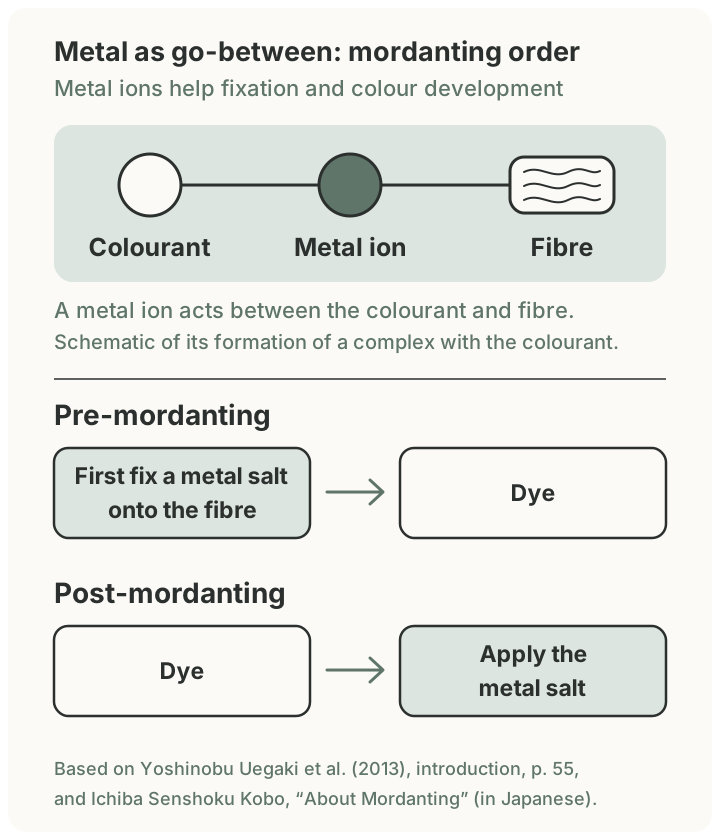
A metal ion sits between the colourant and the fibre, forming a complex that holds it in place.
See
A blog run by a support group for IKTT (the Institute for Khmer Traditional Textiles), a traditional textile workshop in Cambodia, records a result from IKTT: in dyeing with lac-insect nests, an alum mordant gave red and an iron mordant gave purple. The insect's colourant is the same; the metal it is combined with separates the colours.[1]
Evidence for this paragraph (1)
[1]
Scope: IKTT's lac-dyeing results
 practitioner's record ・
 checked against the source by AI
According to the records of Higo Senshoku, a dyeing workshop, the mud dyeing of Amami Oshima has a similar scene. The trunk of the Teichigi (Sharinbai) tree is chipped and boiled for 16 hours or more, and the liquor is left to ferment for about 10 days. Yarn is dipped in this liquor. It is then dipped in a mud field rich in iron, and the yarn turns black.[1][2] Higo Senshoku explains this black as a reaction between the tannin in the Sharinbai liquor and the iron in the mud. The strength of that claim, however, differs from source to source.[2]
Evidence for this paragraph (2)
[1]
Scope: as described by the Higo Senshoku workshop's own process
[2]
Scope: regarding Oshima Tsumugi mud-dyeing on Amami Oshima
 institutional summary ・
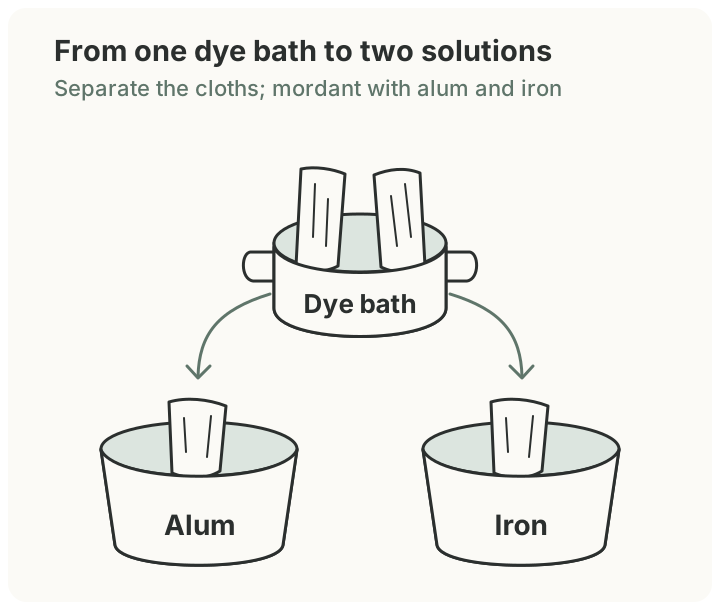
Ask
In both records the colourant itself is the same, yet the metal it is combined with changes the colour and holds it in the cloth. What is the metal doing in the dye bath?
Explain
The go-between called a mordant
According to a paper by Yoshinobu Uegaki and colleagues, many natural dyes do not take well to fibre on their own. So the fibre is soaked in a liquid containing a small amount of a metal (iron, copper, aluminium, chromium and so on), which helps the dye to fix and to develop its colour. The metal-containing liquid that plays this go-between role is the mordant.[1] Ichiba Senshoku Kobo, a dyeing studio, explains that the main agent in a mordant is the metal ion. The dye molecule and the metal ion join by coordination bonding, and the result is a complex that does not dissolve in water.[2] A complex is a compound formed when molecules such as dyes attach to a metal ion, and the way they attach is called a coordination bond. In a coordination bond, the molecule donates a pair of its electrons to the metal. The studio also says that the colour changes with the metal because of a shift in colour tone as electrons move, together with an increase in the stability of the complex.[3]
Evidence for this paragraph (3)
[1]
Scope: Plant dyes that bond poorly to fibre in general (e.g. kakishibu, madder, safflower), per the paper's introduction
 textbook ・
[2]
Scope: Natural (plant) dyeing in general
[3]
Scope: Natural dyeing in general, as an explanation for why different mordant metals give different colours
 experimental ・
A review by Pizzicato and colleagues lists aluminium, iron, copper, tin, chromium and others as the metal salts used as mordants, and says that aluminium-based salts are the most common.[1] The same review says that in animal (protein) fibres the mordant binds to the fibre first and the dye then binds to the mordant. In cellulose fibres the mordant stays on the fibre as a compound that does not dissolve in water, and the dye binds to that.[2] A review by Benli gives as an example the complex formed between the amino and carboxyl groups of wool and the phenolic hydroxyl groups of a plant dye, and explains that dye, fibre and mordant together form a complicated chemical structure.[3]
Evidence for this paragraph (3)
[1]
Scope: Natural-dye mordanting in general, per this review
[2]
Scope: Natural-dye mordanting in general, per this review
[3]
Scope: Wool combined with phenolic plant dyes, per this review
The same idea of coordination bonding also appears in synthetic dyes. In "Dye Chemistry for Dyeing Technologists" (Part 7), a series in the Journal of the Textile Machinery Society of Japan (in Japanese), Kunihiko Imada contrasts two kinds of dye. One is the acid mordant dye, which forms a chromium complex on the wool when the fibre is treated with dichromate. The other is the metal-complex acid dye, in which the dye has already been complexed with a metal before dyeing. Because the latter forms coordination bonds with the metal through the oxygen atoms flanking the azo group, Imada says, it has higher lightfastness than a dye without such bonds.[1][2] Fastness is how well a colour resists transferring or fading; here it means resistance to light. Imada adds that for acid mordant dyes the "afterchrome method", in which the fabric is dyed first and then treated with dichromate, is now the usual one, and that on wool almost no hexavalent chromium is left in the effluent.[3]
Evidence for this paragraph (3)
[1]
1 source: 染色技術者のための染料化学(その7)6.2 金属錯塩酸性染料 6.3 酸性媒染染料 · full evidence
[2]
2 sources: 染色技術者のための染料化学(その7)6.2 金属錯塩酸性染料 6.3 酸性媒染染料; 14. Wool Dyeing Principles and Techniques (WOOL482/582 Wool Processing, Notes – Topic 14) · full evidence
[3]
Scope: Chrome-mordanting process for acid mordant dyes (wool vs nylon)
Pre-mordanting and post-mordanting
The paper by Uegaki and colleagues describes pre-mordanting as fixing a metal salt onto the fibre before dyeing, and post-mordanting as dyeing first and then applying the metal salt.[1][2] In post-mordanting the dye is already adsorbed on the fibre, so the action of the metal ion is described as relatively simple, and the method is said to be especially effective for dyes that only develop their colour with the help of a mordant.[3] The review by Pizzicato and colleagues says that iron salts are often used as an after-treatment to deepen the colour once dyeing is finished. Copper is mainly used as a post-mordant, sometimes as a pre-mordant, but it needs care in handling and disposal.[4][5] The conditions that decide which of the two to choose do not appear in the sources this site has checked.
Evidence for this paragraph (5)
[1]
Scope: Natural (plant) dyeing in general, per the paper's introduction
[2]
Scope: Natural (plant) dyeing in general, per the paper's introduction
[3]
Scope: Natural dyeing in general, per the paper's section 3.2, citing ref. [6]
[4]
Scope: Natural-dye mordanting in general, per this review
[5]
Scope: Natural-dye mordanting in general, per this review
Alum: an aluminium mordant
Ichiba Senshoku Kobo says that alum is the easiest mordant to try at home.[1] Maiwa explains that alum (potassium aluminium sulfate) is the mordant most often used on both animal and plant fibres, that it improves the light- and water-fastness of natural dyes, and that it keeps colours clear.[2] According to Igual Luis, the Tolfa alum deposits came into operation in the early 1460s.[3] Postrel tells the story of the discovery this way: Giovanni de Castro, from Padua, found a mineral tasting of alunite in the Tolfa hills west of Rome, and wrote to Pope Pius II announcing a "victory over the Turk".[4] According to Igual Luis, a papal bull of 1465 banned the sale of Turkish alum in Christian countries.[5] In the account of Pliny presented by Graves-Brown, Egyptian alum was highly prized in the Roman world and was exported as a mordant for wool.[6]
Evidence for this paragraph (6)
[1]
Scope: Home natural dyeing
[2]
Scope: Protein and cellulose fibres in general, per this dye retailer's technical notes
 manufacturer statement ・
[3]
Scope: shipment records to the Spanish kingdoms (Castile and Aragon), per figures compiled by Delumeau
 historical record ・
[4]
Scope: the anecdote surrounding the discovery of Tolfa alum in the early 1460s
[5]
Scope: the papal bulls of 1465 and 1506
[6]
Scope: Regarding the 1st-century Roman world, per Pliny (via this secondary source).
Tannin and iron black: an explanation that splits
The reaction in which tannin and iron combine to turn black appears in dyeing in several regions. According to the Japan Dental Association, Japanese ohaguro (the custom of blackening the teeth) alternates two liquids: "fushiko" (gallnut powder), whose main component is tannin, and "kanemizu" (iron liquor), whose main component is ferrous acetate.[1] Unreacted ferrous ions are oxidised by oxygen in the breath to ferric ions, which then combine with unreacted tannin. The product is ferric tannate, which barely dissolves in water and covers the surface of the tooth.[2] Higo Senshoku and several other sources explain that the black of Amami Oshima mud dyeing, too, comes from a reaction between the tannin in the Sharinbai liquor and the iron in the mud field. Here again, how firmly this explanation is put differs from source to source.[3] Limaye and colleagues ran experiments on Bogolanfini, the mud cloth of Mali. They compared cloth made by the traditional method with cotton fibres impregnated with a solution of tannin and an iron salt, using infrared spectroscopy, scanning electron microscopy and XANES. They report that the black can be explained mainly by a reaction of tannin and iron, but the claim is at a preliminary stage.[4]
Evidence for this paragraph (4)
[1]
[2]
[3]
Scope: regarding Oshima Tsumugi mud-dyeing on Amami Oshima
[4]
Scope: a comparison of traditional Bogolan cloth with tannin/iron-salt-impregnated cotton fibres (confirmed from the peer-reviewed journal abstract only)
Even among researchers, the mechanism by which tannin and iron turn black is disputed. In Eusman's 1998 account of the black pigment of iron gall ink, Wunderlich takes it to be a three-dimensional structure in which iron(III) is bound to the hydroxyl and carboxyl groups of gallic acid, while Krekel takes it to be a complex of iron with pyrogallol rather than with gallic acid.[1] A 2022 review by Melo and colleagues presents yet another view. The main component of a gallnut tannin extract may be gallotannin, and Mössbauer spectroscopy work suggests that iron(III)–gallate complexes bonded through carboxylate groups cannot form at the pH of ink preparation (2 to 3). Iron oxyhydroxide clusters covered by a shell of polymerised phenol oxidation products are proposed as closer to reality.[2] Which is right, the complex theory or the nanoparticle (oxyhydroxide cluster) theory, is not settled within the sources this site has checked. The blacks of Amami and Mali mud dyeing have both been explained by tannin and iron. But according to the records of Higo Senshoku and the Bowers Museum, the materials and the processes are different.[3][4] To conclude that these are two appearances of the same reaction is not yet possible from this site's comparison of its sources.
Evidence for this paragraph (4)
[1]
Scope: the chemical structure of iron gall ink's black pigment, per Wunderlich's and Krekel's differing theories
[2]
Scope: the chemical model for iron gall ink's black colour: the older iron-gallate model versus the recent iron-oxyhydroxide model
 analytical ・
[3]
Scope: as described by the Higo Senshoku workshop's own process
[4]
Scope: Bamana bogolanfini, per the description of this museum object
Another metal black: logwood and chromium
Tannin and iron are not the only route to a metal-made black. According to the Association for the Promotion of Traditional Craft Industries and Tsukamoto Ichida Co., Ltd., "sando-guro" ("three-time black") of Kyo-kuro-montsuki-zome (Kyoto black formal-wear dyeing), one pass consists of brushing the liquid onto the front, back and front of the fabric again (hikizome). Three different liquids are applied in the following order, one pass each. The first is a brush-dyeing with logwood. The second is a brush-dyeing with a reducing liquor ("noir") made by adding various mordanting agents to logwood. The third is a brush-dyeing with dichromate, which oxidises the logwood and develops the colour. The name comes from dyeing three times in all.[1][2][3][4] The Association's page says that sando-guro is sometimes used in Kyo-kuro-montsuki-zome but is mostly a technique used in Kyo-yuzen and similar crafts.[5] A blog by staff of the kimono shop Tsukamoto Ichida says that dichromate at too high a concentration makes the fabric brittle. It also says that over the years the black faded to a reddish "yokan colour", and that this was favoured. Neither claim has been verified.[6][7]
Evidence for this paragraph (7)
[1]
[2]
[3]
[4]
[5]
[6]
[7]
Copper and chromium in waste liquor
Maiwa says that of the metals used for mordanting, chromium, copper and tin work well but harm health and produce hazardous waste that needs special disposal, so it does not recommend them.[1][2][3] Ichiba Senshoku Kobo likewise says that cadmium and chromium were used as mordants until not long ago, but that their use has fallen because of safety concerns.[1] According to the Ministry of the Environment, under the general effluent standard of Japan's Water Pollution Control Act the allowable limits are 0.2 mg Cr(VI)/L for hexavalent chromium compounds, 2 mg/L for chromium content and 3 mg/L for copper content.[4][5] The ZDHC wastewater guidelines for the textile and leather industries give guide values that are stricter than the law, in stages: 0.2 to 0.05 mg/L for total chromium and 0.05 to 0.001 mg/L for hexavalent chromium. They state explicitly that these do not replace compliance with the law.[6][7]
Evidence for this paragraph (7)
[1]
Scope: Black-shade natural dyeing (as described across several sources regarding the decline of chromium mordant use due to toxicity)
[2]
Scope: This dye retailer's (Maiwa, Canada) policy
[3]
Scope: This dye retailer's (Maiwa, Canada) policy
[4]
 standard definition ・
[5]
[6]
[7]
Check the conditions
The recipes so far concern mainly wool. Miki Senryoten, a dye shop, lists the chemicals it uses for each of aluminium, tin, chromium and iron as mordants for wool.[1][2][3][4][5] LANDSCAPE (Kazuko Inamura) goes further and gives a concrete recipe, with an auxiliary added to water at 40 times the weight of the wool, at 90 to 100°C for 30 to 60 minutes, together with the chemical and the concentration for each metal.[6][7][8][9][10] The numerical recipe comes from LANDSCAPE alone. Miki Senryoten shows only which chemical corresponds to which role. iroai.jp explains that fastness also tends to differ by metal. Alum (aluminium) mordanting fades or changes colour easily under light and acidic sweat, while copper mordanting has excellent lightfastness but shows marked colour change and staining from sweat.[11][12] None of these are measured values or comparisons across manufacturers. In the material from the Association for the Promotion of Traditional Craft Industries, sando-guro is a process whose first pass uses logwood, and its use in Kyo-kuro-montsuki-zome is limited.[13][14] Imada's account of acid mordant dyes concerns synthetic dyes and wool and nylon only. That is a different subject from the mordanting of natural dyes, and the source says no more than that the two are linked by the same idea of coordination bonding.[15][16]
Evidence for this paragraph (16)
[1]
Scope: Mordanting of wool in plant dyeing, per this retailer's practice.
[2]
Scope: Mordanting of wool in plant dyeing, per this retailer's practice.
[3]
Scope: Mordanting of wool in plant dyeing, per this retailer's practice.
[4]
Scope: Mordanting of wool in plant dyeing, per this retailer's practice.
[5]
Scope: Mordanting of wool in plant dyeing, per this retailer's practice.
[6]
Scope: Aluminium mordanting of wool, per this workshop's recipe.
[7]
Scope: Copper mordanting of wool, per this workshop's recipe.
[8]
Scope: Chrome mordanting of wool, per this workshop's recipe.
[9]
Scope: Iron mordanting of wool, per this workshop's own recipe and product.
[10]
Scope: Tin mordanting of wool, per this workshop's recipe.
[11]
Scope: Alum mordanting in plant dyeing, per this source's general account
[12]
Scope: Copper mordanting in plant dyeing, per this source's general account
[13]
[14]
[15]
1 source: 染色技術者のための染料化学(その7)6.2 金属錯塩酸性染料 6.3 酸性媒染染料 · full evidence
[16]
Scope: Chrome-mordanting process for acid mordant dyes (wool vs nylon)
Look again
Back to the result recorded by the blog of the group supporting IKTT. From the sources so far, this site can put forward an explanation of why red and purple separated in the lac dyeing: the metal ion joined with the dye molecule and, through the exchange of electrons, formed complexes of different colours.[1][2][3] This is this site's reading. It applies the general explanation of Ichiba Senshoku Kobo and others to IKTT's record, and it was not confirmed with that dye liquor. Higo Senshoku and several other sources say the black of the Amami mud field is a tannin-iron reaction. But how to describe the substance of that reaction is still unsettled, as Eusman's account and the review by Melo and colleagues show, even among researchers of iron gall ink.[4][5][6] What can be checked the next time you look at a cloth is which metal the colour comes from, whether the cloth was dipped in it before or after dyeing, and where the liquid containing that metal goes once the dyeing is over.
Evidence for this paragraph (6)
[1]
Scope: IKTT's lac-dyeing results
[2]
Scope: Natural (plant) dyeing in general
[3]
Scope: Natural dyeing in general, as an explanation for why different mordant metals give different colours
[4]
Scope: regarding Oshima Tsumugi mud-dyeing on Amami Oshima
[5]
Scope: the chemical structure of iron gall ink's black pigment, per Wunderlich's and Krekel's differing theories
[6]
Scope: the chemical model for iron gall ink's black colour: the older iron-gallate model versus the recent iron-oxyhydroxide model
Terms in this theme
- Mordant
- Pre-mordanting
- Post-mordanting
- Alum (potassium aluminium sulfate)
- Kyo-kuro-montsuki-zome (Kyoto black formal-wear dyeing)
- Sando-guro / logwood mordant black-dyeing
- Oshima Tsumugi mud-dyeing
- Bogolanfini (mud cloth)
- Ohaguro (tooth blackening)
- Lac insect
Questions (🧪 marks those that could be tested at home)
- 🧪 What decides whether to pre-mordant or post-mordant?
- 🧪 In the mud dyeing of Amami and of Mali, what do the materials and processes that make the black have in common, and how do they differ?
- 🧪 If the same cloth is dipped alternately in an aqueous solution of gallnut (tannic acid) and in aqueous solutions of ferrous sulfate and ferrous acetate, and dyed black, how do the shade and the fastness differ?
- 🧪 In iron mordanting of wool, how do iron(II) (ferrous acetate) and iron(III) (ferric acetate) differ in the colour and fastness of the result?
- 🧪 Does the improvement in lightfastness from making an aluminium lake of carminic acid also occur when calcium or iron is used as the mordant?
- 🧪 If alum solution is painted onto a cloth with a brush and the cloth is then dyed with madder (alizarin), does only the painted area come out deeper red?
- How much do the mud-dyeing of Amami, ohaguro and iron gall ink have in common chemically, and how much do they differ, in terms of the kind of tannin, the valence of the iron and the reaction conditions?
- For the structure of the black pigment in iron gall ink, how do the Wunderlich and Krekel theories presented by Eusman relate to the "iron oxyhydroxide nanoparticle" theory presented in the review by Melo and colleagues?
- Is it fair to say that using alum or iron in plant dyeing works by the same mechanism as the acid mordant dyes among synthetic dyes?
- If the mordant waste liquor from home plant dyeing (copper, iron, aluminium and so on) has its pH adjusted so that the metals precipitate before it is poured away, what changes compared with pouring it away as it is?
The limitations noted for some sources are recorded in Japanese only — see the Japanese edition.