Theme — how colour stays in cloth
Dissolving in
A nearly insoluble dye is finely dispersed, and the small amount that dissolves works its way into the polyester.
See
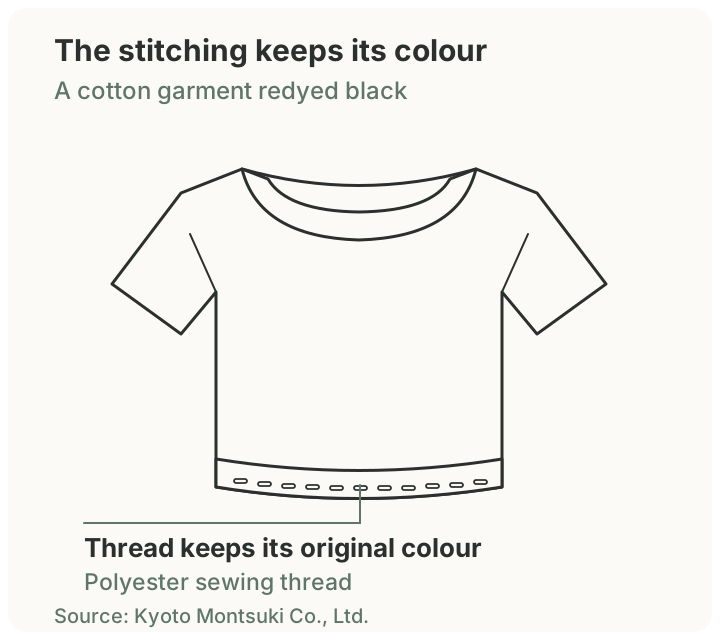
The usage guide for the black-dyeing service KUROZOME REWEAR, run by Kyoto Montsuki Co., Ltd., says that when a white garment is dyed black, the sewing thread may remain as white stitching. The same guide says that sewing thread and buttonhole stitching are often polyester, and that these parts stay their original colour.[1]
Evidence for this paragraph (1)
[1]
Scope: The KUROZOME REWEAR black-dyeing service
 manufacturer statement ・
 checked against the source by AI
A home-dye product page shows a similar situation. The product page for Cooldye Hot, from Katsuraya Fine Goods Co., Ltd. (Miyako-zome), lists "none" under auxiliaries for polyester, and places polyester in the category that dyes only "lightly" unless a colour-deepening accelerator is added. The page says that to dye polyester to a deep shade, you need to add the accelerator and dye with heat.[1]
Evidence for this paragraph (1)
[1]
Scope: Dyeing polyester with Cold Dye Hot (Katsuraya Finegoods)
Both guides show a case where the way a dye takes depends on the type of fibre. In the Kyoto Montsuki guide, the sewing thread, often polyester, keeps its original colour. On the Cooldye Hot page, polyester falls into the category that takes only a pale colour without an auxiliary. This site's reading is that a single class of dyes, disperse dyes, is involved at this boundary. However, as we will see later, it has not been confirmed whether Cooldye Hot is a dye of this class. We will check this against sources below.
Ask
Within the range this site has checked, the dyes used for cotton do not dye polyester. So how does a dye made specifically for polyester get inside the fibre, and how does it stay there?
Explain
Using a dye that does not dissolve in water, without dissolving it
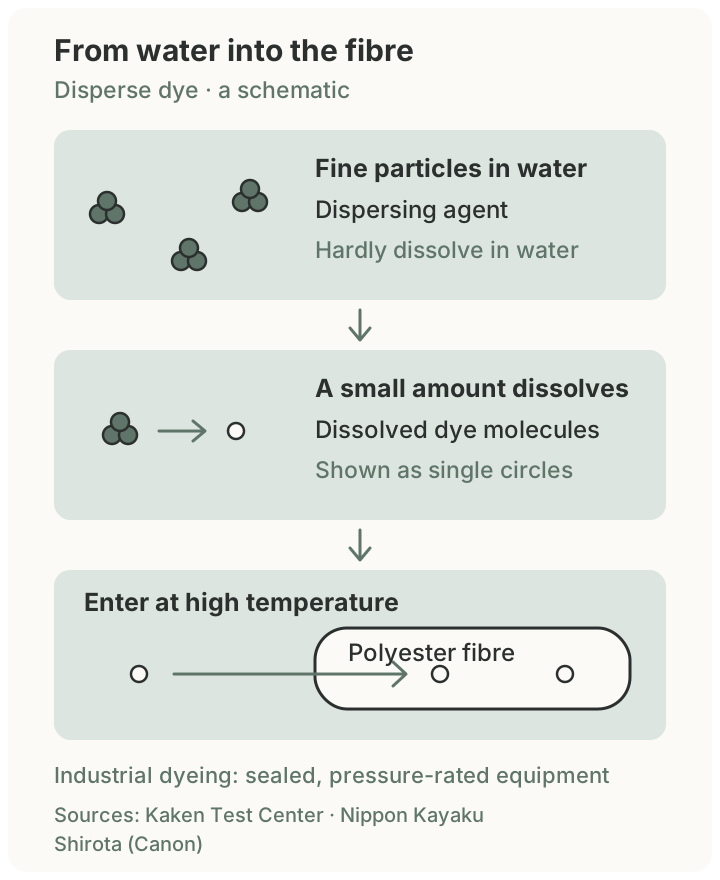
The Kaken Test Center, a Japanese textile testing foundation, describes disperse dyes as "dyes that do not dissolve in water".[1] Kaken goes on to say that the dye is scattered finely in the water by the action of a dispersing agent (a surfactant), and that the small amount of dye molecules that dissolve are what dye the fibre.[2] Kunihiko Imada defines them in a similar way in Part 8 of his series "Dye Chemistry for Dyeing Technologists" in the Journal of the Textile Machinery Society of Japan (in Japanese). Dyes that hardly dissolve in water and are used to dye hydrophobic fibres (fibres that do not take up water readily), such as acetate and polyester, are called disperse dyes.[2] Kaken says this class can dye polyester, acetate, nylon, acrylic, vinylon and polyurethane.[3][4][5][6][7][8]
Evidence for this paragraph (8)
[1]
Scope: nearly insoluble
 institutional summary ・
[2]
 textbook ・
[3]
[4]
[5]
Scope: As stated on Kaken's short explainer page; no test conditions or sources are given
[6]
Scope: As stated on Kaken's short explainer page; no test conditions or sources are given
[7]
[8]
In the same article, Imada also lists structural features that disperse dyes share. Their molecules have no easily water-soluble groups, such as sulphonic acid or carboxylic acid groups, and their molecular weight is roughly 250–750, smaller than that of other dye classes. Precisely because they have nothing that makes them dissolve, he says, dye makers grind them into fine particles beforehand and finish them as products that disperse readily in water in a colloidal state (an extremely fine suspension of particles that do not settle out).[1]
Evidence for this paragraph (1)
[1]
Scope: Structural features of disperse dyes
On reactive dyes, which dye cotton, Dharma Trading Co. says they suit natural fibres such as cotton, rayon, wool and silk, but will not dye synthetics.[1] In the part of the same series that covers reactive dyes, Imada says that in polyester/cotton blends, reactive dyes are used on the cellulosic-fibre side.[2] In the range this site has read, neither source explains why the synthetic side does not take the dye.
Evidence for this paragraph (2)
[1]
1 source: Fiber Reactive Dye: General Information · full evidence
[2]
1 source: 染色技術者のための染料化学(その3)2. 反応染料 · full evidence
The practitioner Paula Burch explains that ready-made clothing is often sewn with polyester thread, and that dyes meant for cotton and other natural fibres do not colour polyester, so a dedicated dye class, disperse dye, is needed.[1] For thread that will not take the dye, she also suggests looking for garments sewn with thread that does dye, or dyeing the fabric first and having it sewn with thread that matches.[2] This site's reading is that the white stitching in the opening scene is an example of this boundary showing up on a product.
Evidence for this paragraph (2)
[1]
Scope: Sewing thread in ready-made clothing
 practitioner's record ・
[2]
Scope: Overdyeing ready-made garments (workarounds for sewing thread that will not take the dye)
A sealed vessel, and a pot left at normal pressure
In its technical guide "Kayalon Polyester Dyes: Dyeing Technical Guide" (in Japanese), Nippon Kayaku describes how polyester is dyed with disperse dyes at high temperature in industry. A sealed, pressure-rated dyeing machine is used, and a mildly acidic dye bath (about pH 4.5–5; the liquid holding the dye and auxiliaries) is heated from around 60°C to 120–135°C. For regular-type polyester the temperature is usually 130°C. The bath is held at that temperature for 30–90 minutes. Nippon Kayaku adds, however, that the proper dyeing temperature varies with factors such as the fibre material, the dye type and the weave structure.[1] Imada likewise gives standard dyeing temperatures that differ by fibre: polyester 130°C, triacetate 120°C, nylon and acrylic 100°C, and acetate 80–100°C.[2]
Evidence for this paragraph (2)
[1]
Scope: Industrial high-temperature disperse dyeing of polyester
[2]
Scope: High-temperature exhaust dyeing of polyester etc. with disperse dyes
Imada also presents a different method, carrier dyeing. It uses a carrier (an auxiliary) at 4 g/L, together with acetic acid (pH 5) and so on; the bath is held at 60°C for 20 minutes, then heated to 98–100°C and held for 60–90 minutes. In the range this site has read, however, the article does not explain how the carrier makes dyeing possible at normal pressure.[1] Presenting this as a method that does not use sealed, high-pressure equipment is this site's reading.
Evidence for this paragraph (1)
[1]
Scope: Carrier dyeing method for polyester
In another part of the same technical guide, Nippon Kayaku says that most carriers (the same thing as the carrier mentioned above) sharply lower light fastness (how well the colour resists fading in sunlight and the like) if they stay in the cloth. For that reason they must be driven off by dry-heat treatment at 150–180°C.[1] For after-treatment, it says that reduction clearing (washing in a liquid containing a reducing agent, to remove dye left on the fibre surface) is normally carried out straight away, to remove unfixed dye and dirt.[2] It lists three dyeing auxiliaries (chemicals that help the dyeing): a dispersing agent that keeps the dye dispersed, a levelling agent that reduces uneven dyeing, and a sequestrant that prevents discolouration caused by metal ions.[3]
Evidence for this paragraph (3)
[1]
Scope: This manufacturer's technical-manual description of carrier dyeing of polyester
[2]
Scope: Post-treatment after Kayalon Polyester disperse dyeing
[3]
Scope: Auxiliaries used in Kayalon Polyester disperse dyeing
What happens in a home pot
With home dyes, the situation is a little different. Jacquard Products describes how to use iDye Poly: a dye in a dissolvable packet is dropped into a pot of hot water, the fabric or object to be dyed is added, and the pot is brought to a simmer.[1] The company presents iDye Poly as virtually the only dye that will colour polyester, and says it can colour almost any synthetic material, including nylon, plastics and wigs.[2] For blended fabrics, it says, the dye can be used in the same dye bath as iDye for natural fibres, and it says iDye Poly can also be used for sublimation-transfer work and for colouring the polyester thread that ready-made clothing is sewn with.[3]
Evidence for this paragraph (3)
[1]
Scope: How to use iDye Poly
[2]
Scope: Materials iDye Poly can dye
[3]
Scope: Applications and use of iDye Poly
The glossary page on the same company's website gives iDye Poly as an example of a disperse dye (the entry is titled "Disperse dye"). It also says that disperse dyes have the unusual property of sublimating (a solid turning directly into a gas without becoming a liquid) even though they do not dissolve in water.[1] In the main text of a page about direct dyes, Burch also describes the company's iDye as a line of direct dyes and iDye Poly as a line of disperse dyes.[2]
Evidence for this paragraph (2)
[1]
Scope: Jacquard Products' own website Glossary page, entry "Disperse dye"
[2]
Scope: As one paragraph of the body of the page "About Direct Dyes" of Burch's hand-dyeing site (shown as updated December 2009), in the section on where to buy direct dyes. It is written in the first person and sits outside the page's advertisement boxes. For iDye Poly it mentions only polyester and blends, not nylon, acrylic or acetate. It does not say whether the term disperse dye comes from the company's description or from the writer's own check. The same paragraph says the writer does not know which individual dyes iDye contains, that the company calls them all proprietary blends, and that no lightfastness or washfastness data are therefore available. It describes no dyeing conditions or tests of the result
 read by AI (not yet checked)
The product page for Polyester Dye from Katsuraya Fine Goods (Miyako-zome), on the other hand, says that it must be used with heat at about 90°C, that the supplied colour-deepening accelerator must be added, and that a heat-resistant container is needed.[1] In none of the product pages this site has checked is this dye stated to be a disperse dye. The same is true of Cooldye Hot. Katsuraya Fine Goods also says that Polyester Dye dyes polyester to a deeper shade than Cooldye Hot does.[2]
Evidence for this paragraph (2)
[1]
Scope: Miyako-zome Polyester Dye product page (the seller's own guidance). The page gives no dye class name
[2]
Scope: Materials Miyako-zome Polyester Dye can dye
What follows is this site's reading. A home pot is an open pot at normal pressure, and the conditions differ from the sealed dyeing at 120–135°C that Nippon Kayaku describes for industry.[1] In the range this site has searched, we have found no material in which a company itself explains how its home products dye polyester under these conditions. For iDye Poly, Jacquard Products itself and Burch both call it a disperse dye. For the two Miyako-zome products (Polyester Dye and Cooldye Hot), by contrast, whether they dye by the same mechanism remains an unconfirmed question.
Evidence for this paragraph (1)
[1]
Scope: Industrial high-temperature disperse dyeing of polyester
Two faces of the tendency to sublimate
The Jacquard Products glossary said that disperse dyes sublimate even though they do not dissolve in water. This property can work for good or ill; that is this site's reading. Below we look, in turn, at an example where it works badly and one where it is used deliberately.
As an example of the unwelcome side, the BOKEN Quality Evaluation Institute, a Japanese textile testing foundation, describes a phenomenon called thermal migration. Disperse dyes used on polyester move to the fibre surface under high temperature, which leads to colour transferring (migrating) to other fabric in contact. It says the smaller the dye particles, the more readily this happens.[1] As reported accidents, BOKEN gives a case where red colour migrated onto white fabric that had been stored stacked with it, and cases where migration was found after container transport or after goods were taken out of a car in summer.[2]
Evidence for this paragraph (2)
[1]
1 source: ポリエステル製品に発生してしまう”昇華移染”にお困りではないでしょうか?(トピックス No.337) · full evidence
[2]
1 source: ポリエステル製品に発生してしまう”昇華移染”にお困りではないでしょうか?(トピックス No.337) · full evidence
In "Apparel Sanpomichi" ("Apparel Stroll"; in Japanese), a column published by the Nissenken Quality Evaluation Center, a Japanese textile testing foundation, Kiyoshima (formerly of Descente Ltd.) describes a case where a white pigment print (a design fixed on cloth with a resin) on a dark polyester shirt turned pink while in stock.[1] As countermeasures, Kiyoshima lists checking in advance with a sublimation fastness test (JIS L 0854; fastness here means how well colour resists changing or transferring to other fabrics when heated), reduction clearing, and the use of thin interleaving paper (anti-sublimation paper). Kiyoshima says the basic test condition is 120°C for 80 minutes, though some companies use other conditions.[2] Kaken's explanation of the test says that after the test piece has been in the oven, colour change and staining (colour transfer) are graded with the grey scale (a reference scale for judging the degree of change in steps).[3]
Evidence for this paragraph (3)
[1]
1 source: 第53回:ケーススタディ⑨色の変化~汚染・色泣き~(アパレル散歩道) · full evidence
[2]
1 source: 第53回:ケーススタディ⑨色の変化~汚染・色泣き~(アパレル散歩道) · full evidence
[3]
Scope: Sublimation fastness test (JIS L 0854)
 standard definition ・
On the side where it is used deliberately, the same tendency to sublimate is thought to be what sublimation-transfer printing (a way of decorating cloth by transferring sublimated dye to it) relies on. Akaya of Nippon Kayaku explains that inkjet printing with disperse dyes (one way of applying dye to cloth to match a pattern) can be classified by fixation method (the way the dye is fixed to the fibre) into three: direct printing (wet-heat fixation), sublimation-transfer printing (dry-heat fixation) and direct printing (dry-heat fixation, or direct sublimation).[1]
Evidence for this paragraph (1)
[1]
Scope: inkjet textile printing with disperse dye
Shirota of Canon Inc. says that disperse dye diffuses into the gaps in the amorphous regions of polyester fibre (parts where the molecules are not neatly aligned) and takes hold there. Because the gaps are very small, steam or a heat press is needed to open up the molecular chains and let dye molecules in.[1] Shirota also says that in the direct printing (wet-heat fixation) method, it is essential to apply to polyester, which does not hold water well, a pretreatment agent that does hold water.[2]
Evidence for this paragraph (2)
[1]
Scope: disperse dye and polyester fibre
[2]
Scope: disperse ink under the direct/wet-heat-fixed printing method
The Jacquard Products product page says that iDye Poly can also be used for sublimation-transfer work.[1] The same property that is reported as an accident when dye migrates is also used as a technique on purpose. This site's reading is that these are two sides of the same phenomenon, sublimation.
Evidence for this paragraph (1)
[1]
Scope: Applications and use of iDye Poly
Check the conditions
The explanation so far holds under the following conditions. First, the fibres Imada gives as the target of disperse dyes are hydrophobic ones such as acetate and polyester, and the fibres Kaken lists are polyester, acetate, nylon, acrylic and the like. The dyes used for cotton and linen belong to a different class.[1][2] Second, the figures for industrial high-temperature dyeing are from Nippon Kayaku, and those for carrier dyeing are from Imada; they are not measured values from a home pot.[3][4] Third, in the range this site has checked, iDye Poly is the only product whose maker's own material states that it is a disperse dye. We cannot say for certain that the two Miyako-zome products dye by the same mechanism.[5][6] Fourth, the countermeasures against thermal migration (reduction clearing, interleaving paper) rest on what Kiyoshima set out from the standpoint of apparel quality control. Whether the same effect can be had at home has not been confirmed, either in the sources or by this site.[7]
Evidence for this paragraph (7)
[1]
[2]
[3]
Scope: Industrial high-temperature disperse dyeing of polyester
[4]
Scope: Carrier dyeing method for polyester
[5]
Scope: Jacquard Products' own website Glossary page, entry "Disperse dye"
[6]
Scope: Miyako-zome Polyester Dye product page (the seller's own guidance). The page gives no dye class name
[7]
1 source: 第53回:ケーススタディ⑨色の変化~汚染・色泣き~(アパレル散歩道) · full evidence
Look again
The white stitching in the opening scene and the thinly dyed polyester lie on either side of the same boundary; that is this site's reading. Burch explains that polyester sewing thread needs a dedicated dye class, disperse dye.[1] Nippon Kayaku says that in industry these disperse dyes are used in sealed, high-temperature dyeing machines.[2] That a home pot differs from those conditions is, as noted above, this site's reading. The next time you look at a garment you own, compare the colour of the thread in the seams, the fibre composition on the care label, and whether the dye packaging uses the words "disperse dye". You may start to see where this boundary lies.
Evidence for this paragraph (2)
[1]
Scope: Sewing thread in ready-made clothing
[2]
Scope: Industrial high-temperature disperse dyeing of polyester
Terms in this theme
- Disperse dye
- Polyester
- Dyeing from a dispersion of sparingly soluble dye
- Dispersing agent (surfactant)
- High-temperature exhaust dyeing method for polyester
- Carrier dyeing method
- Carrier (for disperse dyeing)
- iDye Poly
- Polyester Dye
- Cooldye Hot
- Thermal migration (of disperse dye)
- Heat-transfer printing
Pigments are a different story: like disperse dyes they do not dissolve in water, but they are held on the cloth as particles by a resin. For those, see the theme Glued on.
Questions (🧪 marks those that could be tested at home)
- 🧪 Do home polyester dyes (Miyako-zome Polyester Dye, iDye Poly) actually dye by the disperse-dye mechanism?
- Can the reasons polyester does not take the dye at home be laid out and compared by conditions?
- 🧪 Without the colour-deepening accelerator, how deep a shade will Cooldye Hot dye polyester?
- Is the "colour-deepening accelerator" for Cooldye Hot and Polyester Dye the same kind of chemical, in function, as the industrial carrier?
- 🧪 After using a disperse dye at home, does an after-treatment close to reduction clearing (soaking in hot water, a reducing agent and alkali) visibly reduce colour transfer by sublimation?
The limitations noted for some sources are recorded in Japanese only — see the Japanese edition.